Physical Address
The Woodlands, TX, USA
Physical Address
The Woodlands, TX, USA
The problem of horizon division has fascinated me ever since I started studying astrology. I have published several articles on the subject but never arrived to a conclusion. When it comes to the houses, I have always taken an agnostic stance. It was quite possible to list a number of advantages and disadvantages for each system. And one single method, the GOH houses, was completely discredited by a thorough astronomical analysis. However, I refrained from expressing a preference for any particular method. I see it as an advantage that I do not give consultations: I do not need to be convinced that the system I use works, which is a prerequisite for making an interpretation. I believe this can contribute to an open approach to the problem.
However, my agnostic position has been shaken. An article by David E. Bustamante was recently published: “Astronomical Fidelity in Historical Coordinate Systems of Celestial Partitioning: Quantitative Comparison of Linear vs. non-Linear Measurements.” In this article, Bustamante presents compelling arguments in favour of Placidus.
Placidus
I wrote about the Placidus method of house division earlier in the Nieuwsbrief (Newsletter) from the NVWOA and argued having doubts about Placidus. I must revise the conclusion of that article. Allow me summarise the fundamental characteristics of the method.
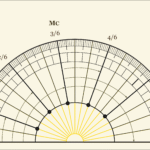
For each cusp, it is true that it has travelled exactly a certain amount of the time between rising and setting (the diurnal arc) or of the time between setting and rising (the nocturnal arc). For cusp 12, for example, this constitutes 1/6 of the diurnal arc; for cusp 11, 2/6; for cusp 10, 3/6, etcetera. In this method, as in many others, the ASC corresponds to cusp 1, whereas the MC, to cusp 10. In order to discern which house a planet is in, look again at the time between the rise and set of that planetary body, its diurnal arc (or, conversely, the nocturnal arc), and determine what amount of its own diurnal arc (or nocturnal arc) it has travelled. If a planet has travelled 25% of its diurnal arc, that is more than the diurnal arc of [, or amount of time required for,] cusp 12 (1/6 or 16.67%) and less than the diurnal arc of [, or amount of time required for,] cusp 11 (2/6, or 33.3%). The planet is therefore between the cusp of the eleventh house and the cusp of the twelfth house, or in the eleventh house.
Difficult to calculate
This is a fairly simple principle, but its calculation [or application] is complex and time-consuming. For intermediate cusps, one cannot directly calculate the length. One can only confirm whether a certain length [amount of time] has met the criteria aforementioned. The calculation, therefore, is ultimately conducting multiple attempts until the difference becomes acceptable, that is, less than 1 arc second. Should you want to calculate this by hand, it will require a considerable amount of time.
One of Bustamante’s arguments is that multiple methods of partition ultimately are simplified calculations of Placidus. These calculations were exploited because the original [i.e. Ptolemaic] calculation was far too time-consuming. Historically, this can be clearly demonstrated. Most methods were presented as the correct application of the concept of Claudius Ptolemy. Even though Ptolemy did not write on houses, he does provide the calculation for primary directions, providing, therefore, a definition that corresponds to that of Placidus. Furthermore, Maginus, the original [trigonometric] developer of the method named after Placidus, and Regiomontanus, both stated that they based their work upon Ptolemy. Simplified calculations for Placidus were still in use until nearly a century ago.
Linear or proportional
The Placidian calculation is proportional [i.e. recognises the extension/length of each diurnal arc]. One divides not space but time.[1] Time constitutes a fundamental variable in astrology. The division into day and night produces unequal values. At the geographical latitude of the Netherlands, a day or night can last between 8 and 16 hours. As one divides each day and night into 12 hours, one obtains unequal [or seasonal] hours, and their length varies throughout the year. As one examines Regiomontanus and Campanus, for example, one observes that the celestial equator (Regiomontanus) or the prime vertical (Campanus) are divided into 12 equal segments. Bustamante regards this as a linear approach [through which all ascensional times become uniformed]. Regiomontanus uses the points produced upon the celestial equator for its circles of position (from the north point of the horizon to south point), which are oblique to the plane of the equator and also to that of the ecliptic. With Campanus, the circles of position are perpendicular to the prime vertical, but oblique to the plane of the ecliptic. Are these natural constructions? I don’t think so.
With Placidus, we can observe that the distribution is natural. The proportional distribution of time yields cusps that always match reality. The position of the cusps varies automatically in accordance with their declination and the geographical latitude. The main argument rests upon the fact that Placidus works consistently with time and not with a constructed [i.e. arbitrary] spatial distribution.
Bustamante states:
[…] ecliptic degrees, or cusps, rest not upon the celestial equator nor upon the prime vertical. Consequently, the astronomical phenomenon responsible of the two angular points—diurnal motion or obliquity—must be the same astronomical phenomenon responsible of any cusp, angular or otherwise. Any ecliptic degree serving as the cusp of a house sector, is, directly, the point of intersection between the ecliptic and a specific point upon the local horizon (not upon the celestial equator nor upon the prime vertical) at a specific moment in time, pursuant to or in accordance with the seasons.
Conclusion
Bustamante presents good arguments. Anyone seeking to delve deeper into this topic would do well to download his paper. This will not end the discussion about the methods of house division, but it will contribute to a better foundation for that discussion.[2] I find the arguments so compelling that I am no longer agnostic on house division and feel inclined towards Placidus. As one can never be completely certain, I remain curious about possible counterarguments, provided that they present a sound astronomical/mathematical basis. Claimed results are not good arguments: supporters of each different method use it, without making their claims verifiable, for which reason such arguments are not distinctive. The issue rests upon understanding how a horoscope is constructed and determining whether this is conducted in a manner consistent.
References
__________________________
[1] (Note from the editor of the English translation.) Time, according to its modern definition, that is, as a coordinate inextricably linked to space.
[2] (Note from the editor of the English translation.) Even though the fidelity to the local sky is not a matter of choice or of philosophy, but of necessity, for symbols are not arbitrary (stem from natural phenomena), the end of the discussion or debate is dependent upon said understanding: that symbols are not arbitrary. The technical discussion, in turn, that is, the one that concerns which methodology reflects the local sky as is, can be considered scientifically concluded by the evidence presented in the paper. Hence Mr. Kampherbeek’s just warning or condition: “[…] provided that they present a sound astronomical/mathematical basis.”
CLICK HERE TO READ THE ORIGINAL DUTCH PUBLICATION IN THE NVWOA NEWSLETTER