Physical Address
The Woodlands, TX, USA
Physical Address
The Woodlands, TX, USA


The prevailing assumption in contemporary astrological discourse is that celestial partitioning systems—commonly referred to as “house systems”—are a matter of philosophical preference, aesthetic choice, or biographical resonance. This premise constitutes a severe epistemological fallacy.
A method of celestial partitioning is, in accordance with its mathematical definition, an instrument of geometric measurement. A physician does not seek to validate the accuracy of a broken thermometer based upon the patient’s subjective reaction (pursuit of statistical ghosts). In turn, the variety of measuring instruments does not grant the observer the right to negotiate the boiling point of water (category mistake). Temperature is an invariant reality; the instrument is either faithful to that reality or it is a broken artifact. Likewise, the mere existence of multiple methods of coordinate transformation does not imply that the topocentric position of a celestial body constitutes a matter of opinion, tradition, or democracy (same category mistake). It constitutes a measurable and falsifiable physical phenomenon. Attempting to plot the true position of an ecliptic point (a solar footprint with a unique declination, azimuth, and altitude) deploying flat Euclidean geometry upon fixed frames of reference foreign to diurnal motion creates an illusion of symmetry that predictably fractures when subjected to the kinetic, non-linear reality of diurnal motion.
The following taxonomy strips this debate of its habitual historical mysticism, reducing the primary systems to their rawest mechanical axioms in order to expose the exact trigonometric threshold where their topocentric fidelity inevitably collapses.
1. The Epoch: Geometric Amnesia and Historical Regression
Reading the table from a chronological perspective reveals a profound historical regression. In the 2nd century, Ptolemy operated from an irrefutable kinetic premise: the ascension of the ecliptic (where the tropical Zodiac lies and, consequently, the cusps of the houses at any latitude) is not uniform across the globe throughout the year. He grounds his methodology in the strict non-linear kinetic reality of the phenomenon: the 1/6th proportion is applied with respect to each diurnal arc, revealing thereby the natural cuspal degree.
During the Middle Ages and the Renaissance (10th to 15th centuries), however, authors such as Alcabitius, Campanus, and Regiomontanus abandoned the proportionality of the specific circle of declination (a calculation William Lilly would later describe in the 17th century as exceptionally “laborious”; Christian Astrology, III, p. 651) in favour of an artificial spatial (Campanus, Regiomontanus) or temporal (Alcabitius) symmetry with respect to the local horizon. That is, the oblique or non-uniform ascension of the ecliptic became standardised through the equal division of frames of reference alien to the apparent angular path of the cuspal degree (relevant diurnal arc), rather than executing the proportional partition of each individual arc (as with every Asc and MC).
It was not until the 17th century with Placidus (building upon Ptolemy and Giovanni Antonio Magini) that the discipline recovered its original, mathematically sound kinetic framework, aided largely by the recent invention of logarithms by Napier in 1614. The table visually demonstrates that in celestial partitioning, neither antiquity nor modernity equate to greater rigour (fallacies known as ad antiquitatem and ad novitatem, respectively); the medieval period represented a collapse of spherical literacy, a retreat from Ptolemy’s kinetic 3D engine into a Euclidean flatness that prioritised the ease of the drawing board over the reality of the sky.
2. The Autopsy of “Uniform” Systems (Alcabitius and Koch)
Categorising Alcabitius and Koch as “uniform” systems is not an arbitrary simplification by the author of this taxonomy, but an inherent limitation of the methods themselves. Hence the precision of their governing mathematical principle: “unique declination” (the Ascendant for Alcabitius; the Midheaven for Koch). This immediately exposes their structural flaw: they extract the specific temporal reality of a single ecliptic point and mechanically extrapolate it across the rest of the celestial sphere. Mathematically, this procedure is unsustainable. Every ecliptic degree constitutes a function of its specific declination (possessing its own diurnal arc) as an individual solar footprint. It is impossible to transfer the kinetic reality of the Ascendant to the eleventh (11th) or twelfth (12th) cusps. Their degrees represent temporally distinct moments of declination (corresponding to different dates). The table renders this logical fallacy geometrically obvious.
3. The Tangential Trap of Polich (Topocentric System)
3.1. A common misconception: A considerable portion of the contemporary astrological community adopts the presumably “topocentric” system of Polich under the assumption that it resolves the nearly parallel rise of the ecliptic (the simultaneous ascent of three sectors or an entire quadrant) at high latitudes. The Exercise column demystifies this assumption: its operational mechanics are reduced to “multiple points of tangency,” a trigonometric technique more sensitive to the curvature of the diurnal arc (the path of the cuspal degree) than the segmentations of Campanus of Novara and Regiomontanus, but insufficient, nonetheless.
3.2. Principle: It is a fundamental geometric axiom that a tangent (a linear vector) is not equivalent to an arc (a spherical curve). The methodology introduced by Polich and Page relies upon the trigonometric tangent of the latitude (tan ϕ) to mathematically project the trajectory of the diurnal semi-arc (Polich, 1976, pp. 18-19, 48-49). At equatorial and lower latitudes, this linear tangent closely, almost exactly parallels the spherical curve of the celestial body’s path, rendering the temporal discrepancy negligible. However, as the observer’s location progresses toward oblique latitudes, the spherical curvature of the diurnal motion becomes increasingly pronounced with respect to the horizon. Consequently, the linear tangent diverges progressively from the actual non-linear physical trajectory of the zodiacal degree.
3.3. The time of arrival test: Whilst Polich’s tangents provide a highly serviceable—or the most precise linear—approximation, they remain a linear translation of a spherical kinetic phenomenon (a linear vector—tangent—to define a spherical path—arc—), inevitably reaching a geometric breaking point. One cannot map the life of a curve deploying the skeleton of a straight line. Therefore, should we conduct the Solar Footprint Test (see “Astronomical fidelity […] Quantitative comparison”), even Polich’s methodology shows a temporal lag of 6 m 37 s (i.e., 25º Gemini 48’ becomes the twelfth cusp at 4:36:42).
3.4. Redundant Trigonometric Scaffolding. Because the system relies upon straight lines (tangents) that touch the curves, rather than executing a direct proportional temporal division upon the curve itself (Ptolemy/Placidus), its mathematical scaffolding is not only functionally redundant (i.e., Goldberg machine) but also ultimately geometrically untenable. Although Polich respected the principle upon which natural cusps are derived, that is, by trisecting each diurnal arc individually (1976, Ch. 1), Ptolemy in the second century, and Placidus in the seventeenth century, had already achieved this without relying upon linear trigonometric constructions (Placidus does not deploy great circles, as Polich once asserted; 1976, Ch. 1, para. ‘a’). Therefore, the method lacks the topocentricity it claims to possess; it constitutes a trigonometric reformulation of Placidus whose methodological flaw becomes evident at 45° latitude and beyond. It is an exercise in tangency, not in curvature.
4. Visualising the Spatial Disconnect in the “Linear” Category
To rigorously comprehend why “Linear” systems (Campanus, Regiomontanus) reveal their fracture point at 23.5º N/S, it is imperative to examine the foundational planes of reference that informs them. Campanus of Novara sections the prime vertical; Regiomontanus divides the celestial equator. The table illustrates that, because the ecliptic (the actual plane of planetary translation) intersects these fixed frames at oblique and variable angles, any equipartite spatial division of the equator or prime vertical will invariably produce distorted ascensional times upon the ecliptic. The table distills this geometric incompatibility into a single, comparative row.
5. The Pedagogical Application
By exposing students to the mechanical architecture that distinguishes static spatial projection from kinetic temporal proportionality, this table serves as a persistent supporting instrument. It forces the student to abandon the conception of house systems as mere “philosophical choices” and confront them as what they truly are: mechanical models with strict, falsifiable limits. The partitioning of the sky is a problem of topocentric astronomical engineering, not an exercise in metaphysics, esotericism, or symbolic inference.
______________________
Table 1: Mechanical Taxonomy and Topocentric Fidelity of Historical House Systems This comparative matrix classifies the primary methods of celestial partitioning strictly by their foundational geometric principles, operational mechanics, and resulting mathematical limits. By categorising these systems into linear/uniform (static spatial projection) and non-linear (kinetic temporal proportionality) frameworks, the table isolates the physical constraints of each model. It visually demonstrates that methods relying upon equipartite spatial division (e.g., Campanus, Regiomontanus) or the uniform extrapolation of a single declination (e.g., Alcabitius, Koch) inherently distort the Time of Arrival (TOA), fracturing at specific latitudes. Only the non-linear proportional trisection of each individual diurnal and nocturnal arc (Ptolemy/Placidus) maintains 100% topocentric fidelity and absolute kinetic consistency across the entire local horizon.
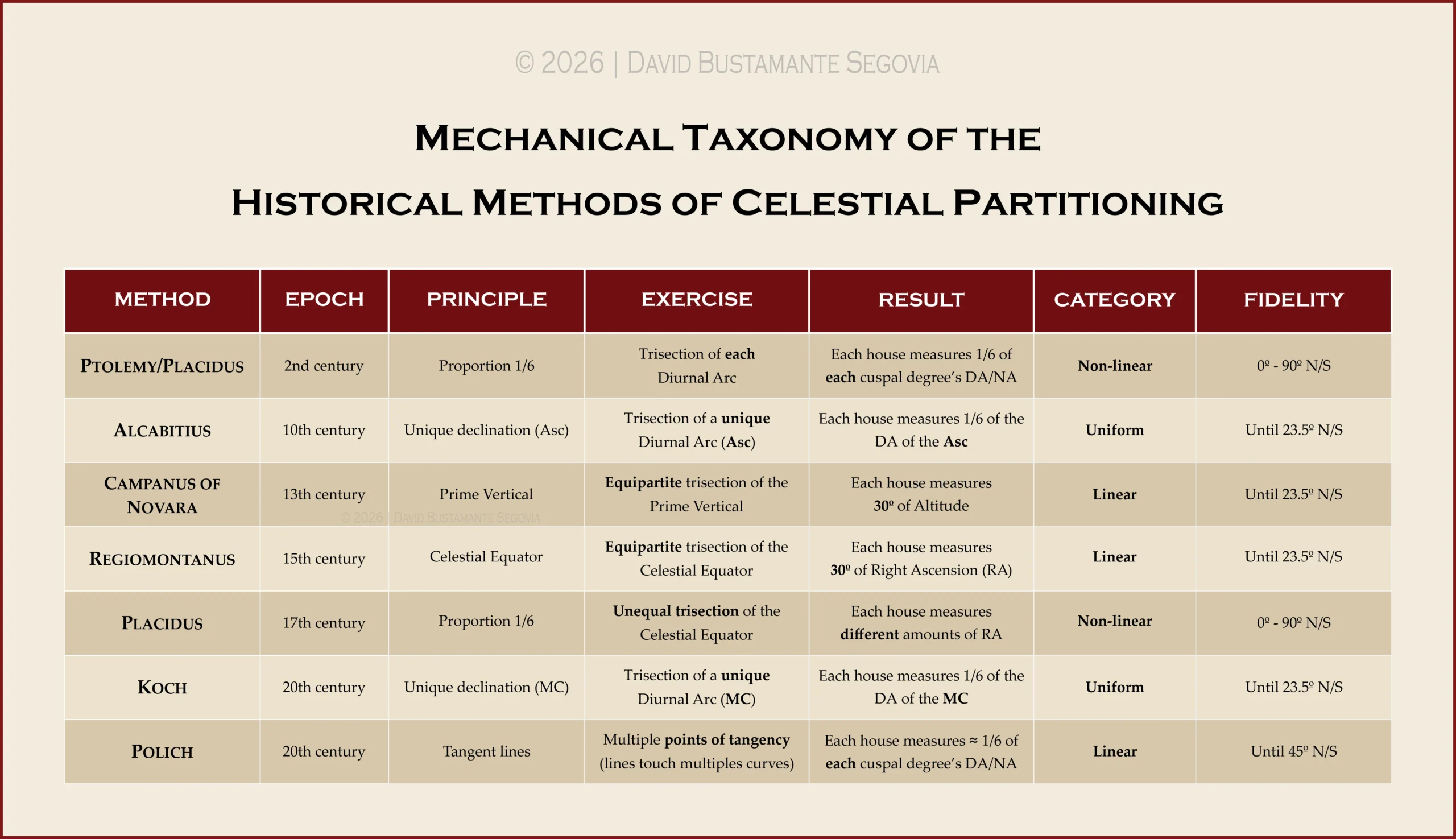
Note: The mathematical fracture point of linear systems at 23.5º of latitude is a direct consequence of the obliquity of the ecliptic. Since the relationship between the ecliptic and the celestial equator is not linear (it is governed by the Earth’s 23.5º axial tilt), structural distortions in ascensional times only become evident beyond the tropics. Within the torrid zones, these geometric discrepancies remain minimal enough to generate a spatial illusion of accuracy. In turn, because the deployment of tangent lines constitutes a geometrically more sensitive or adaptive approximation to the curvature of the diurnal arc than the arbitrary equal-interval segmentation of other reference planes, Polich’s method manages to remain relatively faithful to kinetic reality in low and middle latitudes, containing its cuspal discrepancies within a 1.5-degree margin.