Physical Address
The Woodlands, TX, USA
Physical Address
The Woodlands, TX, USA

Although readers may wish to proceed directly to the forensic analysis of the principal fallacies that permeate the study of celestial inference or astrology, we highly recommend reading these introductory lines.
A Crisis of Accountability
A. Falsifiability. If a topocentric practitioner attributes a terrestrial event to a celestial coordinate, yet mathematical calculation proves the body was never physically present in that specific sector of the local horizon, any interpretive success must be attributed to an alternate synthesis, not to the geometric validity of coordinate transformation method. Coordinate transformation methodologies are not interchangeable aesthetic preferences; they yield quantifiable, geometrically discrepant measurements of a single physical reality: the position of celestial objects lying upon the ecliptic. Therefore, they are also intrinsically falsifiable. To argue otherwise is to assert that because multiple models of thermometers exist, the temperature itself is merely a matter of opinion.
B. The Modern Arbitrary Invention. The contemporary defence framing celestial partitioning as a detached, “symbolic” framework immune to metrological verification is a modern psychological invention, entirely alien to the Hellenistic and medieval architects of the discipline. As confirmed by a direct reading of the original source texts, authors from Vettius Valens (c. 120–175 CE) and Claudius Ptolemy (c. 100–170 CE) to Morin de Villefranche (1583–1656) and Placidus de Titis (1603–1668) inextricably bound the astrological symbol to the topocentric reality. To divorce the symbol from the exact physical position of the object (altitude + azimuth)[1], be it a planetary body or the point of the ecliptic upon which it sits, is not an evolution of the craft; it is a total abandonment of its original geometric mandate.
C. Institutional Accountability. Having abandoned these strict physical mechanisms, the astrological community has cultivated a peculiar immunity to intellectual accountability. Assertions regarding house theory—and celestial inference—routinely violate the exact laws of spherical geometry upon which they purportedly rely. This is rarely an innocent oversight; it manifests as a willful indifference to celestial mechanics. When confronted with the glaring internal contradictions of their preferred frameworks—such as the equatorial trisection of Regiomontanus or that of the prime vertical of Campanus, the topological tangents of Wendel Polich[2] or the single-arc temporal measurements of Alcabitius and Koch—practitioners frequently retreat into relativism, circular reasoning, or ad verecundiam fallacies, fundamentally unable to articulate the basic physics of their own instruments.
D. The Path to Metrological Rigour. This lack of accountability degrades the discipline from a rigorous science of celestial measurement into an insulated collection of unquestionable dogmas, utterly failing to faithfully represent the local horizon it claims to represent in order to scrutinise and diagnose. If topocentric practitioners expect their field to be recognised as a serious domain of inquiry, its “experts” must first be held accountable to the non-negotiable kinematics of the observer’s physical reality. If they cannot mathematically articulate the validity of their coordinate systems, they are not practitioners of a metrological craft; they are merely historical reenactors reciting scripts of dogma.

A Forensic Analysis of the 3 Primary Fallacies
In the preceding analysis we identified the methodological deficits undermining contemporary astrological research, namely, the reliance upon exaggerated inductive reasoning and the abuse of statistical regression. This article, in turn, specifically audits the primary logical and geometric fallacies that render a significant portion of modern empirical studies effectively moot. When researchers employ a structurally fractured instrument—such as a celestial partitioning method inherently incapable of accurately mapping topocentric ecliptic coordinates—or rely upon inductive models that conflate sufficient cause with necessary cause to evaluate inherently polysemic subjects (e.g., Saturn’s arrival at the Medium Coeli), the empirical outcome is compromised. The resulting data does not constitute a valid “negative finding” against the astrological premise. Rather, it represents a profound category error wherein a metrological or mechanical failure is falsely diagnosed as a statistical one.
1. Post-hoc Ergo Propter Hoc (“After this, therefore because of this”)
Post hoc: After this
Ergo: Therefore
Propter hoc: Because of this
Not only can a subject experience a multitude of significant events within a biographical window (January); multiple celestial configurations can correlate or be considered compatible with some of those occurrences (including the one from January 10). Artificially isolating a single terrestrial event to retroactively validate a preferred celestial alignment constitutes an abusive data selection, an example of cherry picking or confirmation bias. Furthermore, while freezing temperatures invariably accompany snowfall, cold weather alone cannot produce precipitation; it is a necessary, but strictly insufficient, condition. This conflation of causal parameters introduces the next logical fallacy.
2. Necessary vs. Sufficient Cause
Following the atmospheric analogy, assuming that a very cold day guarantees a blizzard is to conflate a condition that is merely required with one that guarantees or strongly suggests the outcome (i.e. abuse of inductive reasoning).
These factors range from the combined action of all astrographical placements (contrary to the “procedural guide” of Sun-sign astrology, a consumption good of contemporary western capitalist societies) to terrestrial environmental variables (e.g. society, economy, specific legislation). Hence a reflection traditionally attributed to Ptolemy and/or Morin:
Should you find Jupiter elevated, first you ought to determine if the birth chart belongs to that of a prince or to that of a peasant; should it be the former, you will judge he will be king; should the latter, a merchant
See conceptual origin in Ptolemy, Tetrabiblos, 1940, pp. 17-19
3. Necessary vs. Sufficient Cause in Celestial Inference
A. Conditio nativitatis. While the verbatim phrasing provided is likely a modern translation or a specific author’s paraphrase, the underlying epistemological principle encapsulates a foundational doctrine of traditional astrology: the “Condition of the Native” (or «conditio nativitatis»). It explicitly delineates the boundary between celestial and terrestrial causation. The classic illustration—whereby an elevated Jupiter correlates with a prince ascending to the throne but a peasant merely attaining local magistracy—may appear to be most rigorously codified by the seventeenth-century mathematician Jean-Baptiste Morin de Villefranche.
B. Morin’s Rules of Celestial Inference. In Book 21 of his Astrologia Gallica (1661), Morin formalised the rules of celestial inference and advised that the practitioner must evaluate the native’s genetic, geographical, and socioeconomic circumstances before making a judgment concerning a planetary body’s promise. Furthermore, Morin argued that celestial mechanics do not overwrite terrestrial realities; rather, their physical expression is strictly bounded by the material “vessel” receiving them. Consequently, a highly dignified Jupiter transiting the Medium Coeli acts as a necessary, yet strictly insufficient, cause for absolute wealth or honour; it manifests success only up to the definitive threshold permitted by the native’s preexisting environmental stratum.
C. The Origin of the Aphorism. This doctrine (bounded manifestation) originates with Claudius Ptolemy (Tetrabiblos, 1940, pp. 17-19), who warned that an observer must first account for the “seed” (heredity) and the macro-environment. Ptolemy explicitly noted that identical celestial geometry will yield vastly divergent material outcomes for royal versus common lineages, a premise fundamentally congruent with modern epigenetics. Subsequent medieval and Renaissance practitioners, including Guido Bonatti and Jerome Cardan, repeatedly utilised this “prince vs. peasant” axiom to mandate that planetary dignities remain strictly anchored to the subject’s objective material reality, thereby precluding the abuse of statistical regression across disparate biographical contexts.


4. Necessary vs. Sufficient Cause in Celestial Partitioning
This epistemological fallacy also permeates the structural analysis of historical coordinate systems and advanced timing techniques (e.g., primary directions):
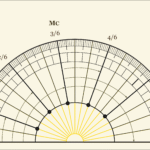
A. Topocentric Construction. Practitioners frequently argue that accurately calculating the four primary angles is a sufficient condition to individualise a celestial map or horoscope. However, this ignores the geometric reality that true topocentric fidelity requires the exact spatiotemporal calculation of all intermediate or sub-angular ecliptic coordinates. While calculating the exact proportional completion of the nocturnal arc (6/6, the Ascendant) and the diurnal arc (3/6, the Medium Coeli) is structurally necessary, it remains strictly insufficient without the equivalent partitioning of the intermediate arcs. A mathematically complete horizon demands the proportional temporal division of every cuspal degree (the kinetic Ptolemaic/Placidian methodology).[3]
B. Apparent Angular Motion. Furthermore, it is presumed that fixed linear instruments (e.g., circles of position) represent a sufficient condition for any valid topocentric measurement (e.g. cuspal degree). This assumption fails to recognise that apparent angular motion exacts a spatiotemporal, rather than purely spatial or Euclidean methodology. Fixed or immovable spatial intersections render these great circles geometrically untenable or obsolete at extreme terrestrial latitudes. While a great circle may be sufficient to successfully plot a primary angle like the MC, only a strictly kinetic measurement—grounded in proportional seasonal times—possesses the necessary mechanical capacity to accurately ascertain intermediate ecliptic coordinates across oblique horizons.
C. Primary Directions. The linearity of a great circle may be sufficient to plot a singular circle of position passing through the centre of an isolated planetary body (as utilised in primary directions). However, this linear mathematical framework is fundamentally insufficient to simultaneously partition the entirety of the ecliptic. Because every individual zodiacal degree possesses a unique declination—and consequently, a variable ascensional time—the local horizon cannot be mapped under the light of a static linear formula that cannot recognise apparent angular motion (topocentric perspective). Instead, it requires a kinetic model capable of satisfying the necessary physical requirements of multi-variable temporal durations.
5. Ad Hoc Hypothesis (“To this [specific purpose]”)
This is the fallacy of methodological rescue.
The Calibration: Three Corrective Syllogisms
1. Cumulative Temporal Discrepancy
The primary failure of linear partitioning constitutes a failure of syllogistic consistency.
By using these imprecise coordinates in statistical research, one commits the Texas sharpshooter’s fallacy: drawing a bullseye of significance around a cluster of “statistical ghosts” that never occupied the physical coordinate one purports to test.
2. Polysemy vs. Punctate Data
The abuse of statistical regression in astrology stems from a failure to understand the nature of the subject matter in accordance with medicine, genetics, and developmental psychology, and even Ptolemy and Morin de Villefranche, as explored in an earlier section (necessary vs. sufficient cause).
Why this constitutes a syllogism of mismatch:
3. The Broken Thermometer Analogy: Utility vs. Truth
Many practitioners defend their preferred method of celestial partitioning by appealing to anecdotal utility or traditional wisdom, frequently relying upon the subjective justification that “it works for me.”
The syllogism of the instrument:

Conclusion
Within celestial partitioning, while we cannot compel the broader community to execute the manual geometric corroborations outlined in this and other audits, refusal guarantees a state of perpetual metrological ignorance. Until practitioners actively verify the mechanical fidelity of their chosen frameworks against the physical reality of the local horizon, they will remain trapped in a fundamental epistemological catastrophe: relentlessly attempting to validate a temperature reading while refusing to ascertain whether their thermometer is submerged in water or suspended in air.
_____________________
[1] If the Sun occupies the exact ecliptic degree of the twelfth-house cusp, its physical altitude and azimuth must mathematically match the topocentric coordinates of that cusp. This geometric parity holds true exclusively within a celestial framework constructed upon the kinematics of diurnal motion. The most definitive way to verify this metrological violation is by testing the prime vertical system of Campanus, wherein the calculated spatial coordinate of the cusp and the physical position of the solar body radically diverge at oblique latitudes (excepting the equinoxes). However, operating strictly within the prime vertical system of Campanus conceals this error, as the practitioner is led to falsely assume that the Campanus cusp shares the solar body’s true physical coordinates. Cross-examining the calculation with a kinetic model (e.g., Placidus) instantly exposes the divergence. While the physical, astronomical position of the Sun remains absolute, the kinetic model yields a fundamentally different ecliptic degree for the cusp, proving that the specific geometric degree assigned by Campanus does not actually reside at the Sun’s physical altitude and azimuth. The use of reference frames foreign to the ecliptic (apparent angular motion) yields inaccurate results.
[2] It is a geometric axiom that a tangent (linear vector) is not equivalent to an arc (spherical curve). The methodology introduced by Wendel Polich and Nelson Page relies upon the tangent of the latitude to mathematically approximate trajectory of the diurnal semi-arc. At lower latitudes, this linear tangent closely, almost exactly parallels the spherical curve of the celestial body’s path, rendering the temporal discrepancy negligible. However, as the observer’s location progresses toward oblique latitudes, the spherical curvature of the diurnal motion becomes increasingly pronounced with respect to the horizon. Therefore, the linear tangent diverges progressively from the actual non-linear physical trajectory of the zodiacal degree. Therefore, while Polich’s tangents provide a highly serviceable—and arguably the most precise linear—approximation, they remain a linear translation of a spherical kinetic phenomenon, inevitably encountering a fracture threshold where the straight line fails to capture the curve. See Wendel, P. (1976). El sistema topocéntrico con tablas de casas y ascensión oblicua para todas las latitudes. Regulus. pp. 18-19, 48-49.
[3] Irrespective of the method of celestial partitioning employed, all angular cusps are mathematically defined by the precise temporal proportions of their respective arcs. The Ascendant (Asc) and Descendant (Des) invariably mark the precise completion (100%) of their respective nocturnal and diurnal arcs (six-sixths). Identically, the Medium Coeli (MC) and Imum Coeli (IC) always constitute precisely 50% (midpoint) of their respective diurnal and nocturnal arcs (three-sixths). Whether tested under Placidian, Regiomontanian, Campanian, or Porphyrian frameworks across varying latitudes, these physical realities (mathematical identities) remain invariant (the twelfth house cuspal degree constitutes the first one-sixth of its own diurnal arc; that of the eleventh, the second one-sixth of its own diurnal arc; etc.). These cuspal degrees fluctuate in accordance with apparent angular motion (latitude-dependent), making them natural or organic cusps in any celestial map.
[4] Idem.