Physical Address
The Woodlands, TX, USA
Physical Address
The Woodlands, TX, USA
A prevalent confusion exists in expert astrological literature (e.g. Rootjes, Carter, Evans, Holden, Houlding, Forrest, Ribeiro, Brennan) concerning the methodological distinctions between the celestial partition methods of Alcabitius (10th century), Placidus (17th century), and/or Koch (20th century), as all three, unlike Regiomontanus’ equatorial method and Campano of Novara’s prime vertical method, dispense with reference frames foreign to the ecliptic in order to measure apparent celestial motion (that is, ascensional times or the changing apparent trajectory of the sun) directly. The ecliptic (or tropical zodiac) is the fundamental frame of reference for traditional topocentric astronomy.
The essential difference between these three systems is that Alcabitius and Koch employ calculational abbreviations that simplify the calculation required by the Ptolemaic methodology. As the former focus upon the semi-arc of a single angular point, the ASC or the MC, the latter requires the uninterrupted and simultaneous measurement of all diurnal arcs (circles of declination) of interest.
Ptolemy/Placidus
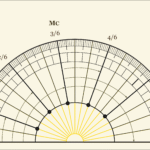
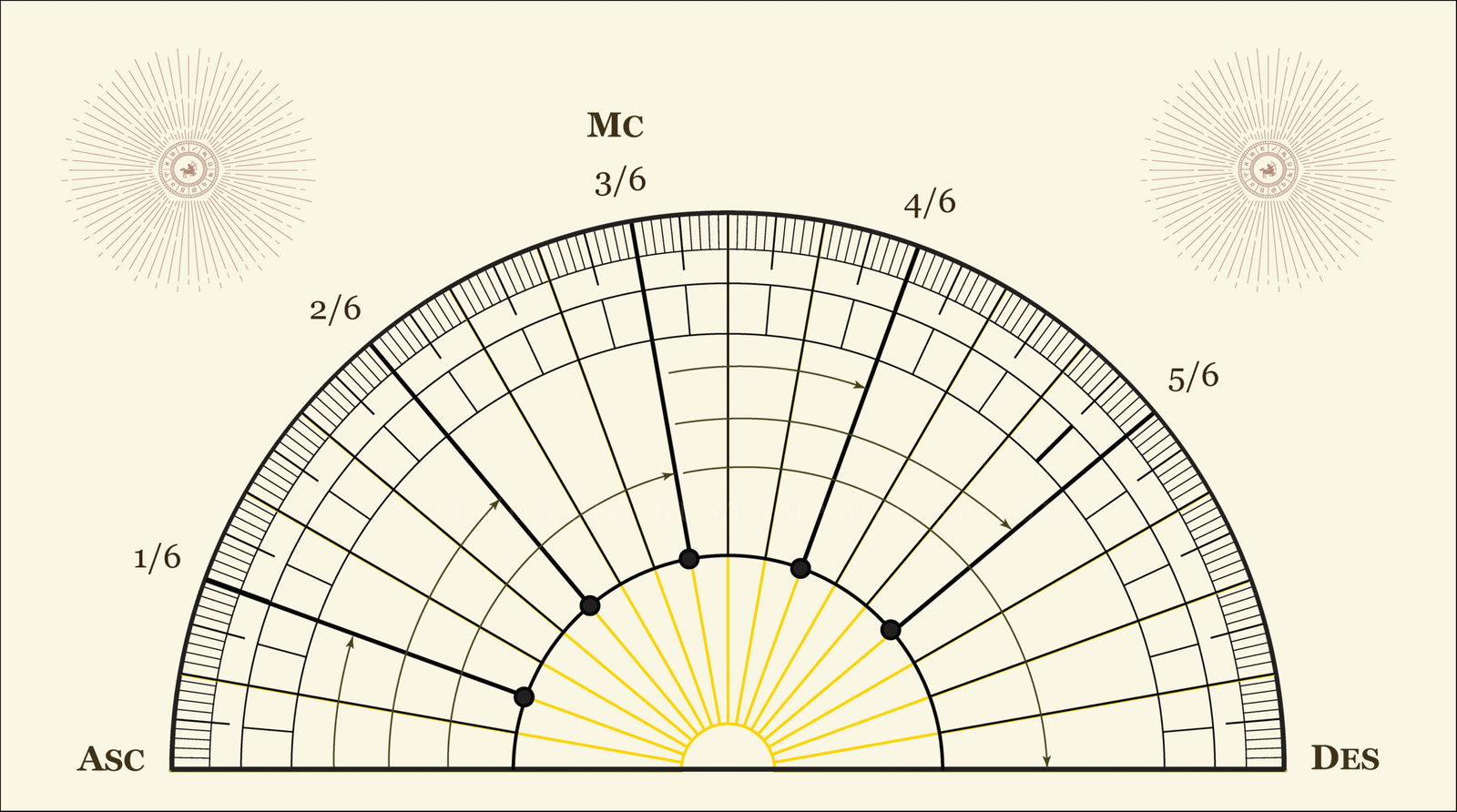
Because the traditional philosophical postulate establishes the necessity of partitioning or dividing the horizon into six segments of equal length above the plane of the local horizon and into six segments of equal length below the same plane in order to intervene six distinct ecliptic points (zodiacal degrees), Ptolemy, as correctly described by his translator F.E. Robbins (1940, Loeb, p. 286), would have determined which six points upon the ecliptic are fulfilling one-, two-, three-, four-, five-, and six-sixths of their own diurnal arc. (Every ASC and every MC, for example, constitutes exactly six-sixths and three-sixths of their own diurnal arc, respectively.)
Therefore, the degree presiding over the twelfth house (or the cuspal degree of that sector of the horizon) has fulfilled the first one-sixth of its diurnal arc, whereas the degree presiding over the ninth house has fulfilled the fourth one-sixth of its diurnal arc. Each house measures only one-sixth of the diurnal time of its cuspal degree (or of the nocturnal time, in the case of a sector of the horizon that lies below).
Alcabitius
Let the amount of time that the degree presiding over the first house would have invested in order to culminate be measured, that is, in order to become the MC from when it was the ASC. Let that amount of diurnal time be divided into three equal lengths of time in order to advance the time of the event in question by one-third of the diurnal semi-arc of that degree (equivalent to one-sixth of the diurnal arc of that degree). Whatever degree now appears transiting the local meridian will serve as the cuspal degree of the eleventh house. Let the time of the event in question be advanced once more, and whatever degree now appears transiting the local meridian will serve as the cuspal degree of the eleventh house. Let this exercise be reproduced yet again, this time with regard to the amount of nocturnal time elapsed from when the same degree (ASC) crossed the local meridian below the horizon until it rose, that is, in becoming the ASC from when it was the IC.
Koch
Let the exercise described above be reproduced. This time, however, by use of the degree constituting the MC. “Let the amount of time that the degree presiding over the [tenth] house would have invested in order to culminate be measured, that is, to become the MC since it was the ASC. Let that amount […].”
Summary
All three houses within an Alcabitius/Koch quadrant measure exactly one-third of the ASC/MC semi-arc (or one-sixth of the ASC/MC arc), while all three houses within a Ptolemaic/Placidian quadrant measure varying or “relative” (Michelsen, p. 30) lengths of time, for we have respected the time of ascension of each point of the ecliptic (zodiacal degree). In other words, the principle according or pursuant to which an ASC or MC is established has been honoured throughout the entire horizon, from cusp to cusp, not just from angular cusp to angular cusp. The phenomenon responsible for each cuspal degree is the same phenomenon responsible for an ASC or a MC: diurnal motion, a phenomenon governed by geographical location (latitude), date (month), and time (local time).
Even though all three understand the necessity of focusing upon the ecliptic (the fundamental frame of reference, as opposed to the celestial equator or the prime vertical), only the Ptolemaic method constitutes a completely organic exercise. Alcabitius and Koch represent two distinct methods of uniformation of ascensional times, thus creating methods of convenience rather than geometric necessity. This explains the strong criticism that both linear methodologies received from Abraham ibn Ezra (12th century) and the general community (20th century).