Physical Address
The Woodlands, TX, USA
Physical Address
The Woodlands, TX, USA


This piece of text briefly examines four errors of formal logic concerning the epistemological and geometric bases that underpin the computational results of diurnal motion in oblique horizons, as already exposed in Astronomical fidelity of celestial partition coordinate systems. Quantitative comparison of linear vs. non-linear methodologies. (Read the executive summary of this paper by clicking here.) The astronomical conformity of the calculation of diurnal motion is further corroborated when we perform a formal logic exercise with regard to the historical arguments that justify or justified the use of linear methodologies in oblique horizons.[1]
Circular reasoning (petitio principii)
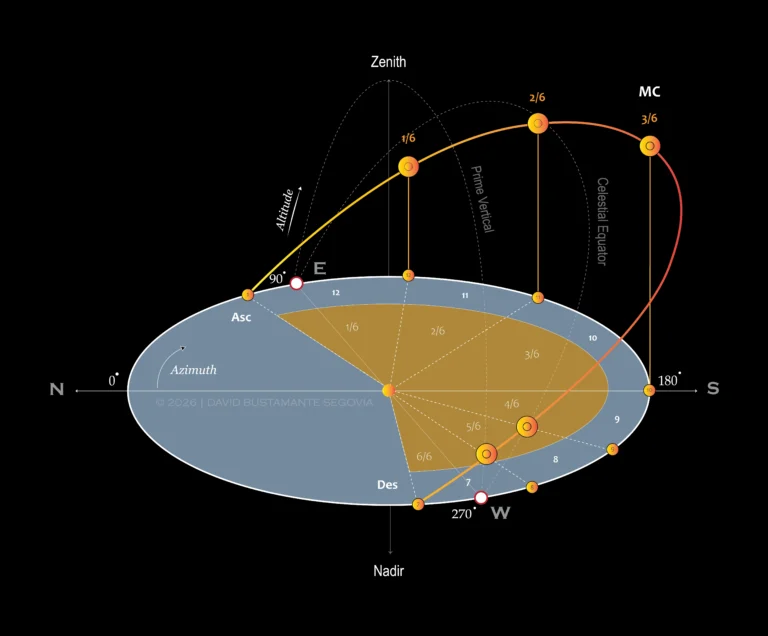
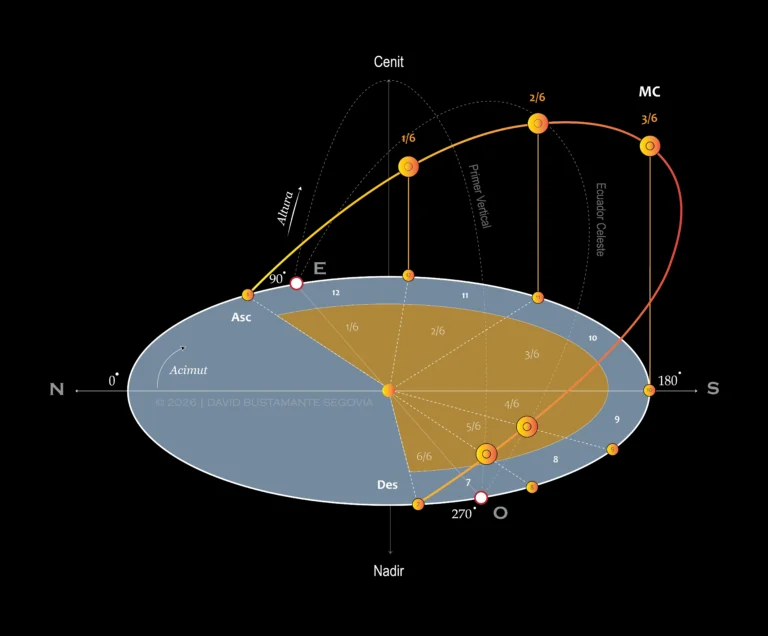
The traditional argument that the celestial equator must serve as the formal measure of time and the principal frame of reference for the ecliptic constitutes a logical circularity. This fallacy arises because the argument presupposes the truth of its conclusion: it asserts that the linear system is correct because it is mathematically consistent with its own starting premise (linearity). It then bears with a logic equivalent to arguing that because a hammer is traditionally used for nails, it cannot be abandoned when a screw requires a screwdriver. Certainly, one cannot argue that a system is correct because it is mathematically consistent with its starting premise, for oblique ascension shows that the starting premise (linearity) is scientifically invalid for modelling the required non-uniform output at the local horizon. The failure of the system to reflect or model non-uniformity implies that its mathematical consistency is internal only, failing the necessary external test of physical reality. Furthermore, Campanus and Regiomontanus having projected their divisions onto the ecliptic (from the prime vertical and the celestial equator, respectively) suggests or otherwise confirms that the ecliptic points’ actual paths (not those of the equator/prime vertical) is the relevant frame of reference. (Figures 1 and 2.)
Contradictory methodology (intellectual dissonance)
An attempt to confirm the fidelity of the equatorial coordinate system experimentally by use of a sample that ignores or omits the phenomenon it purports to measure may be considered contradictory. That is, to advocate for empirical, verifiable primary direction[2] comparisons by relying upon a system that deliberately detaches its measurement from the actual, non-uniform displacement of the celestial body observed or tracked and believed to represent an event promises or lends itself to methodological ‘fraudulence’. Such an approach can confirm correlation only, not causation, and holds, too, a tendency for false positives. We may agree that the integrity of the computational system must be established before its output can be used as experimental evidence.[3] To employ two calculations leading to differing or conflicting coordinates (time, date) cannot be taken to imply that both calculations are correct. A phenomenon cannot be attributed to a cause that is physically impossible (as showed by the times of arrival, Tables 1-5).[4]
Misapplication of Occam’s Razor
The rule requires choosing the simplest explanation that still accounts for all the observed facts. The preference for a computationally simpler linear approximation over a more mathematically complex—albeit conceptually simpler—non-linear method represents a misapplication of Occam’s Razor, however, for the simpler model demonstrably fails to account for the non-uniform displacement of the ecliptic at oblique horizons (demonstrated by the Δt error). This historically justified the necessity of the non-linear system. As Louis (2022) correctly notes, the adoption of a simpler system (equatorial method) never constituted a preference for elegance nor, much less, precision in the case of Lilly, but a constraint imposed by the computational limitations of fifteenth-century trigonometry, which made the complex, non-uniform method originally recommended by Ptolemy too difficult to “operationalize”.[5]
Irrelevant conclusion (ignoratio elenchi)
A common rhetorical challenge against calculations based upon time is the—counterintuitive—critique that their functionality breaks down within polar regions, as if time implied the use or exploit of great circles. Even if this geographical limitation were true[6], to discredit a method upon this basis constitutes the fallacy of the irrelevant conclusion. It would be criticising a specialised tool for not working outside the broad scope for which it was designed, or for failing to account for less than one percent of the globe. A geographical boundary, therefore, would not invalidate the method’s claim to reflect physical reality where it is functional. Furthermore, treating this boundary as a reason to adopt a globally uniform, linear approximation constitutes a leap of faith, requiring acceptance of a conclusion (ascensional uniformity) that is entirely disproportionate to the limited evidence (a specific geographical limit).
_______________________________
[1] The rigorous reader may feel compelled to visit a series of geometric blunders in F. Xavier Kieffer’s Le problème de la domification (1949, Les Cahiers Astrologiques), where the author’s impassionate critique of the equatorial method (Regiomontanus) is, ironically, a perfect condemnation of the method he therein advocated, the prime vertical (Campanus).
[2] Lilly (1647) defined this technique as “[…] The Art of Direction being only to find out in what space of time the Significator [a certain body] shall meet with his Promittor [another body]; or in more plain terms, When, and at what time, or in what year such or such an accident shall come to pass [i.e. an event believed to have been signified or represented by said conjunction]” (2005, p. 651). For a three-dimensional illustration of a natural example of primary direction, See Appendix H: Figure 1 (of the Supplemental Material). The astronomical noncompliance discussed herein implies also that any subsequent “directional” exercise based upon these arbitrary cusps will carry an inherent, embedded flaw.
[3] Houlding writes (1998, The houses: temples of the sky, p. 104-105): “Not only is the system [i.e. diurnal motion/Placidus] sympathetic to the use of these [seasonal] hours, but it is also the system that lends itself to the most ‘natural’ system of Primary Directions […].”
[4] In “The problem of house division,” Skyscript, Houlding states: “The astrological houses do not exist as an astronomical reality; their application is symbolic.” If the houses are purely symbolic (i.e., arbitrary, non-necessary constructs), then they cannot, by definition, possess explanatory or predictive power—within the realm of astrology—beyond coincidence. To claim an event was “caused” or “explained,” “prompted” or “promoted” by the implication inherent in a distinct method of celestial partition that was chosen based upon preference is a grave example of cognitive dissonance. Insofar as one assigns explanatory power to a discipline, one is refrained from contradicting truths confirmed by science.
[5] Each method of horizon division is the result of both the astronomical understanding of the epoch and the state of spherical trigonometry.
[6] See Appendices F and G (of the Supplemental Material) for further explanation and 3D illustration within the polar regions.