Physical Address
The Woodlands, TX, USA
Physical Address
The Woodlands, TX, USA

Acknowledgments. Before commencing, we must extend our profound gratitude to Philip Graves, curator of the Historical Archives of Astrology, for providing the primary source scans transcribed verbatim in this analysis. Those interested in acquiring the original versions of these documents, or exploring the broader historical record, may contact Mr. Graves at solger75@gmail.com or visit his magnificent archive at astrolearn.com. It is difficult to conceive of an astrological text of historical consequence that does not reside within his collection. We strongly encourage our readership not only to utilise his unparalleled resources for their own research, but also to support his ongoing preservation efforts with a donation, however small, for it is paramount.
* * *
For decades, the study of coordinate transformation—traditionally known as house division—has been haunted by a fundamental misidentifications of what is being measured: the conflation of static spatial instruments with the kinematic reality of time. At the epicentre of this historical confusion stands the 20th-century Irish astrologer Cyril Fagan (1896–1970). Whilst rightfully acknowledged for his archival contributions, Mr. Fagan’s aggressive defence of Euclidean frameworks and his vehement critiques of the principle of proportionality (differential calculus) cast a long, intimidating shadow over the astrological understanding of celestial mechanics.
Perhaps nowhere is this geometric misconception more evident than in his infamous critique of Wendel Polich and A.P. Nelson Page’s presupposed Topocentric System. Published in the 1960s, Mr. Fagan’s critique is often cited as a mathematical checkmate. In reality—much like the contemporary critique of F. Xavier Kieffer in Les Cahiers Astrologiques (1949) of the same phenomenon, the kinematics of time—it constitutes a masterclass in epistemological absurdity, trigonometric smokescreens, and astronomical illiteracy.
Mr. Fagan repeatedly wielded a static spatial ruler—specifically, the prime vertical, an axis exploited heavily by 19th-century navigators during the height of British maritime dominance—to measure the continuous rotation of the Earth. He attempted to measure ecliptic points or fluid diurnal arcs of varying lengths with this static grid, and then blamed the mathematics when his ruler inevitably failed. He fundamentally failed to understand that “proportion,” in this context, applies not to static space, but to time and kinematics (Placidus, 1657/1814). Therefore, the principle of temporal proportionality governs the sky irrespective of whether an object sits upon the celestial equator.
It is paramount to set the historical and mathematical record straight. We cannot advance the science of traditional topocentric astronomy (true astrology) until we completely dismantle two prevailing fallacies:
Mr. Fagan’s original text is dense, heavily laden with obsolete maritime navigational jargon, and designed to impress the reader into submission. Reading it unbroken is a recipe for cognitive fatigue. Therefore, we are not presenting our rebuttal as a standard essay. Instead, we offer a guided, forensic dissection.
* * *
To ensure absolute clarity and prevent the reader from becoming entangled in Mr. Fagan’s mathematical presentations, this article is formatted as an interactive autopsy with official sources attached (hyperlinks):
By engaging the text in this manner, you will not only witness the exact mechanisms of these spatial illusions, but you will also understand the immense, misplaced pressure that seemingly drove Polich and Page to justify their kinematics with their own geometric absurdities—a subject we will thoroughly dissect in Part II of this series.
Let us begin the analysis.
(Readers wishing to challenge our observations or debate our historical conclusions are rigorously invited to contact Caelum Stratagem at newsletter@caelumstratagem.com.)
* * *
1966, SPICA, VOL. V, No. 3
THE TOPOCENTRIC SYSTEM OF HOUSES
by Cyril Fagan
Sir,
In his “Directional Astrology” and “Primary Directions Made Easy”, Walter Gornold (Sepharial) endeavoured to popularize Primary Directions under the poles of the significators. Hitherto such directions were made under the pole of the Ascendant, that is, the geographical latitude of the birthplace; or by ‘proportion of semiarcs’.
But as these did not prove convincing, it was presumed that greater accuracy would be obtained should such directions be made under the poles of the chief significators themselves; to wit, the Moon and the Sun. To achieve this apparently desirable result, Sepharial, relying on the writings of earlier astrologers, such as Placido di Titi (Placidus), the author of the “Tabulae primi mobilis” and R. C. Smith, the first “Raphael”, applied to this problem the Rule of Three in an attempt to ascertain the poles of the significators.
Knowing that the poles of the meridians were zero and those of the Ascendant and Descendant identical with the latitude of birth, in consonance with previous astrological arithmeticians in the same field, he argued that “As the semiarc (SA) of the significator is to the pole of the Ascendant, so is its meridian distance (MD) to its pole.”
Thus, had evolved, apparently, a delightfully simple way of determining the pole of any fixed star, or planet. However, unless the semiarc (SA) of the fixed star or planet was a segment of a great circle of the sphere (that is, it had no north or south declination, in which case it is situated precisely upon the equator, which is a great circle of the sphere), this formula could not work! Should a fixed star or planet enjoy any declination, north or south of the equator, its semiarc (SA) was a segment of a small circle of the sphere, lying parallel to the celestial equator (the greater the north or south declination, the smaller the semiarc), in which case this Rule of Three could not, and did not, apply; because all small circles of the sphere form the bases of cones.
Generally speaking, while proportional methods have their rightful places in planar trigonometry, they are not applicable to the resolution of problems of the sphere; as any competent student of spherical trigonometry will testify. But, alas, many uncritical arithmeticians have fallen foul of Sepharial’ s pedantry in this matter; and, seemingly, not the least the authors of the topocentric system of houses!
Spica, 1966, Vol. 5, No. 3, p. 33
Commentary 1: The Two Category Errors
Cyril Mr. Fagan fundamentally misunderstood what Placidus was measuring. His critique relies entirely upon a strawman:
A. Mistaking time for space
Mr. Fagan’s entire argument hinges upon the premise that the “rule of three” (proportional trisection of varying semiarcs) is being applied as a spatial ruler measuring linear distance across a curved surface (spatial partitioning of 30º, i.e., whereby six sectors bear, each, 30º of space). However, Ptolemy/Placidus is measuring time (∆t), not physical distance. The diurnal arc (or semiarc) constitutes a temporal magnitude of the Earth’s uniform rotation (ω), thereby dictating the specific duration that distinct degrees stay above/below the local horizon. Time is universally divisible. The Earth’s rotation (motion) does not care whether a star sits upon a great circle or a small one; the rate of rotation (ω) remains constant.
B. Mistaking kinematics (Placidus, 1657/1814) for planar trigonometry
Mr. Fagan has stated with supreme confidence: “[…] while proportional methods have their rightful places in planar trigonometry, they are not applicable to the resolution of problems of the sphere.” This is arguably the most concerning sentence in his critique. He equates “proportional methods” exclusively with flat, Euclidean geometry, exposing ignorance of differential calculus (relative to the variable lengths of diurnal arcs) or spherical kinematics. Proportional partitioning is the sole method appropriate for the universal goal, that is, for maintaining an equal division across diurnal arcs of varying lengths at a specific moment in time. To conduct an “equal partitioning” of different diurnal arcs at a given moment, one must first model how those arc lengths vary in accordance with their specific declination (δ) and latitude (ϕ); otherwise, there is nothing to partition equally. Spherical kinematics with continuous parameter dependence is therefore required.
Placidus did not employ planar trigonometry; he calculated the variable ascensional times of points on a sphere based upon their declination (δ) and the observer’s latitude (ϕ). This, in turn, is topocentric. Only parallax and atmospheric refraction—which Polich and Page discarded—can make a method of celestial partitioning more topocentric. Mr. Fagan should have mentioned this.
C. Historical irony: the—apparent—birth of the Polichian error
As the reader will see, Mr. Fagan criticises the authors of the presupposed topocentric system as “uncritical arithmeticians,” yet he does so while misunderstanding the very construction they were discussing. He attacks them as though the “rule of three” were intended as a spatial measurement, when the actual phenomenon is temporal in nature. Polich and Page, for their part, appear to have taken that same misreading seriously enough to force the method into an explicitly spatialised framework, rather than admitting that it constitutes a kinematic spherical construction (Placidus).
Apparently, in an attempt to satisfy the spatialists, Polich and Page persisted with their phantom methodology: they continued to literally graft imaginary eccentric cones onto the celestial sphere in order to justify a rigid spatial geometry at the expense of a strictly temporal reality. Neither Mr. Fagan nor Polich fully understood Ptolemy/Placidus. Fagan rejected the method because he treated it as if it were supposed to produce flat spatial equalities; Polich and Page, for their part, attempted to convert a differential temporal procedure into a more rigid spatial geometry. In other words, they distorted spherical geometry to force the mathematics to fit their recent anomalous invention (Casey, 1889).
The pole of a celestial object cannot, usually, be determined until its circle of position (CP) is first ascertained. Here a few definitions are in order:
- A circle of position is a great circle of the sphere which, passing through the body of a celestial object, intersects the rational horizon at its North and South points. Should the celestial object be above the horizon, its circle of position will intersect the prime vertical at right angles. It is usually called a ‘secondary’ [circle to the prime vertical]. It is measured along the prime vertical from the zenith or from the nadir should it be situated below the horizon.
- The prime vertical is a great circle of the sphere, which, rising due East, intersects the meridian at the zenith; then, setting due West, it cuts through the Nadir point; to arise, again, due East. The great circles of the Meridian (0º) and the rational horizon (90º) are, also, circles of position, as are the cusps (“edges”) of the Campano houses, 30º and 60º from the zenith. As the polar axes are situated in the southern and northern meridians, it follows that the poles of the meridian are nil; while those of the rational horizon are identical with the geographical or rather geocentric latitude.
Whence the fatal facility in assuming that the poles of intermediate positions can be obtained by simple proportion, or Rule of Three.
Spica, 1966, Vol. 5, No. 3, pp. 33-34
Commentary 2: The Dogma of the Grid
In this passage, Mr. Fagan perfectly describes a spatial scaffold, yet he completely fails to describe celestial kinematics. By elevating a specific geometric architecture into a universal astronomical law, he confines or subjects his own argument to a fatal logical fallacy:
A. The illusion of spatial scaffolding (circles of position)
Mr. Fagan is measuring uniform distances (thirty degree segments) along the prime vertical using great circles (Bowditch, 1868). However, celestial kinematics is governed by temporal rates of change due to declination, not static spatial projection (a celestial body lies upon the serpentine ecliptic, not upon the immovable prime vertical). To slice the sky with great circles drawn from the poles of the horizon and declare the intersections as “cusps” is to willfully ignore the variable times of ascension of different ecliptic/zodiacal degrees (variable lengths of their diurnal arcs). Because it ignores the planet’s actual declination, the spatial circle mathematically assumes that every object behaves as if it were sitting on the equator—meaning it acts as if every object rose exactly due East. The prime vertical therefore ‘flattens’ the rising points of all planets to the East point, effectively erasing their actual diagonal or natural paths across the local sky.
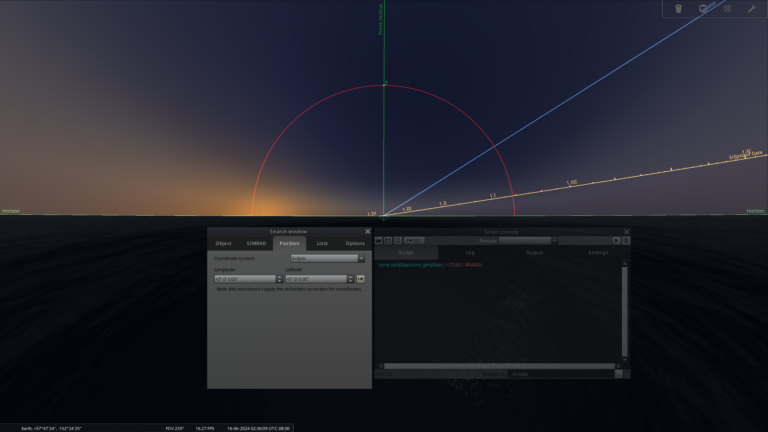
Consequently, the instrument of measurement becomes conflated with the celestial event itself—namely, the true time of arrival at a specific coordinate of the local horizon (azimuth and altitude). Should one place the Sun upon a nonangular Campanian cusp, one can instantaneously verify—via Stellarium or Solar Fire Gold using a Ptolemaic-Placidian calculation—that the physical position (azimuth and altitude) held by the Sun in the local sky does not—and it must—coincide with the position dictated by the Campanian cusp.
What does the above imply? That the exact amount of time required for the Sun to reach that local coordinate (azimuth, altitude) after rising is fundamentally different from the amount of time reported by the prime vertical calculation. The great circles that pass through the 30º altitudinal markers upon the prime vertical fail to reflect the positional truth of ecliptic cusps (Bowditch, 1868) for a very simple astronomical reason: cusps do not live on the prime vertical, nor do they live on the celestial equator. Cusps are zodiacal degrees and are therefore, ecliptic points. They are the literal footprints of the Sun. Any valid method of celestial partitioning must inevitably pass the Solar Footprint Test (or the Local Apparent Solar Time Test).
B. Circular reasoning (begging the question)
Unlike continuous motion or varying rates of ascension, “circles of position” are not a natural phenomenon; they are literally the architectural definition of the Campanus system of houses. Mr. Fagan takes the specific spatial scaffolding of Campanus, declares it the only valid way to measure the sky, and then uses it to “prove” that proportional methods are false, essentially arguing: “The mathematical measurement of time is hereby invalid because it does not align with the static spatial lines I just drew.”
Mr. Fagan forces a non-linear temporal phenomenon into a rigid spatial grid, and when it does not fit, blames the phenomenon. This elevates his geometric misunderstanding from a mere error to a formal dogma. He has locked himself inside a static, Euclidean birdcage, and is proudly declaring to the astrological community that anything moving outside of it violates the laws of both mathematics and physics.
The word “pole” is an abbreviation for “polar elevation” and means the angular distance of the North or South Pole above or below the planet’s circle of position. Obviously, then, to determine its value it is first necessary to compute the planet’s circle of position. There are many formulae for this, known to navigation officers, of the old school, but here are three of the more familiar:
Spica, 1966, Vol. 5, No. 3, p. 34
Commentary 3: Navigational Frames of Reference
In this section, Mr. Fagan attempts to invalidate the Earth’s rotation (diurnal motion) by leveraging maritime terminology (the prime vertical was exploited heavily by navigators during the 18th and 19th centuries). He projects rigid architectural definitions onto fluid temporal formulas, completely misunderstanding the Placidian calculation:
A. The “pole” as a temporal ratio, not a spatial scaffold
Mr. Fagan strictly defines a “pole” within a spatial scaffold (like Campanus or Regiomontanus), assuming it must always refer to the physical, static distance between the Earth’s axis and a rigidly projected great circle. However, in the Ptolemaic/Placidian framework—the exact framework upon which Polich and Page drew their own alternative geometry—the “pole” of a significator is not a spatial line at all; it is a temporal ratio. It represents an artificial latitude—the specific latitude at which a degree’s ascensional difference exactly matches the proportional time (∆t) it has spent above/below the horizon.
B. The obsolescence of the circle of position (CP)
Mr. Fagan assumes that to find a cusp, one must draw a great circle (the CP) to find an intersection. This is the geometric equivalent of saying, “Obviously, to measure the temperature of the water, we must first measure the circumference of the glass.” Because he does not understand that a cusp constitutes a function of its specific declination, and that, therefore, Ptolemy/Placidus (and Polich and Page without fully admitting it) calculates time individually or discriminately via the diurnal semiarc itself, he is blind to the fact that kinematics renders the spatial CP entirely obsolete or irrelevant.
C. Sailing a ship across a clock
Mr. Fagan’s reliance on maritime formulas is the perfect metaphor for the series of errors. Navigators employ spherical trigonometry to chart static physical distances across space; topocentric astronomy employs differential calculus and semiarcs to measure continuous motion or the uninterrupted elapsing of time. This temporal measurement is the only mechanism necessary to reflect the exact diurnal length of an ecliptic point, and therefore, its precise physical position with respect to the local horizon at any given micro-second.
Mr. Fagan conflates the tools of measurement with the celestial event being measured. He fails to see that a true, unified method of house division demands that all intermediate cusps retain the exact mathematical and physical identity of the Ascendant (Asc) and Midheaven (MC). The angular cusps are—also—products of diurnal motion, geographic latitude, and declination—or, simply put, of Local Apparent Solar Time (LAST).
To measure the angular cusps by their exact times of arrival to the horizon and the local meridian—6/6 of the nocturnal arc (Asc) and 3/6 of the diurnal arc (MC)—yet measure the nonangular cusps in a way that completely ignores their own times of arrival to the intermediate regions (1/6 and 2/6 of their arcs) constitutes a glaring geometric contradiction (yet the only method that was not worse than exhausting during the 15th century; see Lilly, III, p. 651).
Mr. Fagan’s formulas are not proof of Placidean error; they are definitive proof that he brought a ruler to measure time. He is attempting to sail a ship across a clock. A ship’s captain ascertains an immovable island in space; he does not measure the temporal phase of a rotating sphere or at which a certain object is.
- Formula No 1
cot CP = sin lat., cosec MD, cot b – cos lat. cot MD
where
CP =
the required angular distance from the zenith or nadir of the circle of position;
Lat. =
the latitude of birth, or place of event, and
MD =
the hour-angle or meridian distance of the planet from the furthermost meridian
b =
the polar distance (or co-declination)
- Formula No 2
tan (B-A) = sin ½ (b-a) cosec ½ (b+a) cot ½ MD
tan (B+A) = cos ½ (b-a) sec ½ (b+a) cot ½ MD
then CP = ½ (B+A) + ½ (B-A)where
b =
the polar distance or co-declination;
a =
the latitude of the place,
MD =
the meridian distance (taken from the meridian furthermost from the planet) and
CP =
the required circle of position.
The polar distance or co-declination (b) is found by subtracting, algebraically, the declination from 90º.Spica, 1966, Vol. 5, No. 3, p. 34
Commentary 4: The Smokescreen of A Conventional Trigonometry
In this section, Mr. Fagan may have attempted to overwhelm the readership with a wall of complex spherical trigonometry. While his equations are mathematically sound in a vacuum, they are entirely irrelevant herein:
A. Flawless math from a flawed premise
The formulas that Mr. Fagan provides—which utilise variations of Napier’s Analogies and standard spherical right-triangle solutions—will flawlessly calculate the dimensions of a static spherical triangle (Lénárt, 2003). However, it is entirely irrelevant. Is constitutes the use of advanced spatial trigonometry to solve a problem of motion or kinematic time. It does not matter how precise Mr. Fagan’s cotangents and cosecants are; he is simply calculating the exact dimensions of an arbitrary geometric ghost. It is a different kind of smokescreen from the one created by Polich. (Whereas Polich’s smokescreen was entirely fictious and/or cynical, Mr. Fagan’s is entirely arbitrary or irrelevant.)
B. The tactic of impression or intimidation
Mr. Fagan’s true goal here would appear to be merely rhetorical, not scientific. He seems to have attempted to impress his readers (especially Polich and Page) with a barrage of advanced mathematics, hoping they will mistake complex spatial equations for kinematic validity. He exploits the sheer density of the math as a smokescreen to dissimulate his misidentification of what is being measured.
Mr. Fagan has executed flawless mathematics upon a fundamentally flawed premise. By applying the rigid rules of static trigonometric distance to the continuous, proportional motion of ascension, one is simply bringing a micrometer to measure a stopwatch.
As all functions in this formula are positive, it should prove more convenient for those who are not too familiar with the handling of negative quantities.
- Formula No 3
tan A = cos lat, tan MD (Taken from the nearest meridian)
tan B = tan lat, cos MD (Taken from the nearest meridian)
C = B – decl (taken algebraically)
CP = A+D
CP = A-D should decl exceed BThe notation is the same as in the previous formulae. An example of the working of this was given in the Mundoscope (AFA Research Bulletin No. 1, 1947).
* * *
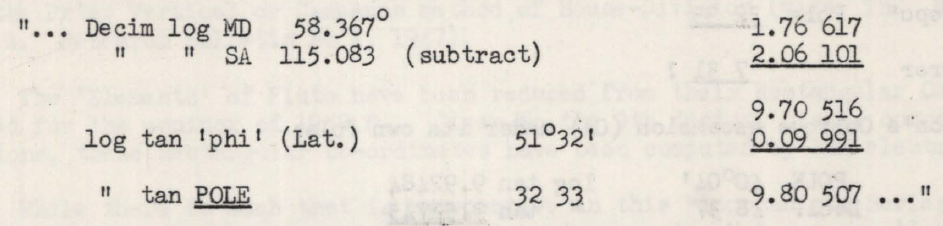
In SPICA, Vol. III, No 3, April 1964 (page 9), the authors of the “Topocentric System of Houses” give the following computation for ascertaining the pole of the Moon: its RA having been given as 115°52’; its decl. as +18°37’; its MD (from the nearest meridian) 58°22’; and its Diurnal Semiarc (SA) 115°05’.
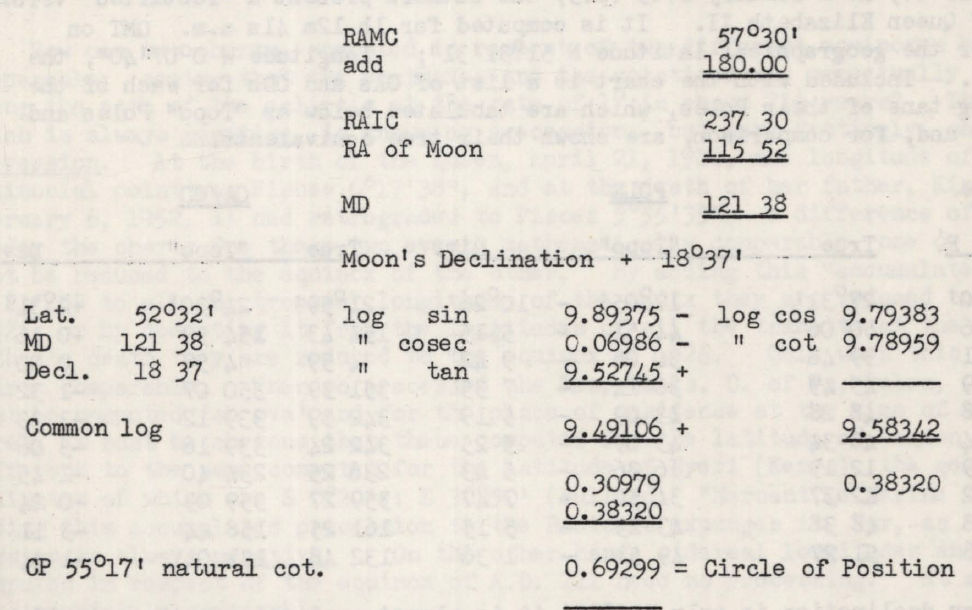
In this computation the authors are, in effect, saying: “As the semiarc (SA) 115.083° is to the pole of the Ascendant 51°32’, so is the meridian distance (MD) of the Moon to its pole 32°33’,” which is simply an attempt to ascertain the Moon’s pole by the rule of three. Let us compute the Moon’s pole as an old sea-salt would probably do it, but the Moon’s circle of position must first be ascertained. Strictly speaking, a navigation officer would rely upon his familiar Haversine Tables to solve this; but assuming these are not available, he would probably choose Formulae No 1, and proceed as follows:
The pole of the Moon is determined from the following simple sin formula:
sin pole = sin CP sin lat. of place
Thus
[…]
True pole 40º 04’
Polich pole 32º 33’
Error 7º 31’ !To find the Moon’s oblique ascension (OA) under its own pole:
[…]
True OA 99º 25’
Polich OA 103º 27’
Error 4º 02’!Spica, 1966, Vol. 5, No. 3, p. 36
Commentary 5: The Tautology of “True” (Campanian) Poles
In this section, Mr. Fagan appears to believe that he is delivering a devastating, mathematically unassailable takedown. In reality, he meticulously documents his own reification.
A. The unfounded a priori premise
By what epistemological authority is the purely spatial (Campanus) intersection the “true” pole (of a point lying upon the ecliptic, not the prime vertical)? Mr. Fagan never proves why the spatial great circle is the correct method for cuspal ascertainment; he simply assumes it a priori. Because he is locked entirely in the paradigm of the “navigation officer”—whose sole task is to project immovable great circles across the globe to sail ships—he assumes the kinematic sky operates within the exact same lifeless architecture.
B. The mathematical tautology
When Fagan calculates the Moon’s circle of position (CP = 55º 17’), he has drawn a rigid, physical “hoop” (a great circle) that starts at the North point of the horizon, passes directly through the physical body of the Moon, and ends at the South point of the horizon. At that exact micro-second, the Moon is indeed physically sitting on that hoop. Fagan then calculates the pole of that specific spatial hoop (not the pole of the ecliptic point occupied by the Moon nor of the Moon itself, should it present celestial latitude). He obtains the value 40º 04’ (this simply indicates that if one tilts the Earth’s axis by 40º 04’, that specific circle of position becomes the new horizon).
After calculating this spatial pole, Mr. Fagan compares it to the temporal—ecliptic—pole (32º 33’), which correctly accounts for the actual declination of the Moon. He then triumphantly declares: “Error 7º 31’.” This is not an error; it is a tautology. He is comparing a static spatial coordinate to a fluid temporal ratio and declaring the temporal ratio “wrong” simply because it does not match his spatial grid. (See paragraph A in Commentary 3.) . It is the geometric equivalent of declaring:
He is comparing two completely different units of measurement—geometry vs. kinematics—and declaring the kinematic one (with respect to the ecliptic, where objects reside) “wrong” because it ‘failed to produce’ the geometric, spatial number (with respect to the prime vertical, where objects do not reside)
C. The Kinematic Conflation
Mr. Fagan’s spatial circle does capture the physical location. However, completely ignores the actual amount of time elapsed since rising. Let us pay careful attention to what Mr. Fagan calculates at the bottom of his math: oblique ascension (OA). Fagan takes his spatial pole (40º 04’) and uses it to calculate the Moon’s ascensional difference (a/d = 16º 27’). He then calculates the Moon’s oblique ascension (99º 25’).
This error is not only obvious but fatal. Oblique ascension is strictly a temporal coordinate. It is the exact degree of the celestial equator that is rising simultaneously with the Moon. It is a measurement of the clock. Because Fagan used a spatial hoop—circle of position—drawn from the North/South points (which mathematically forces the Moon to behave as if it had zero declination and rose due East), his Ascensional Difference is geometrically corrupted. Fagan captured the physical body of the Moon in space, but then used that static, frozen 2D hoop to calculate a time-based coordinate. He applied a spatial geometry to a diurnal, temporal equation.
“Polich’s” OA (103º 27’) is the true, correct temporal oblique ascension, for it is derived directly from the Moon’s actual diurnal semiarc (the clock). Fagan’s OA (99º 25’) is a phantom coordinate. It is what the Moon’s OA would be if the Moon completely ignored its own declination and rode up Mr. Fagan’s solidified spatial hoop instead of its own natural diurnal path.
Because the remainder of Mr. Fagan’s mathematical proofs bear this exact same reasoning and rely entirely upon this false equivalency of coordinates, we refrain from reproducing the rest of his trigonometric calculations. He has built a flawless mathematical house upon a completely fractured foundation.
D. The defective Ptolemaic/Placidean echo
While Polich and Page were epistemologically correct to measure the Moon’s position via differential or proportional time (rather than Fagan’s dead space), their specific computational execution with respect to house cusps—the zodiacal degrees that serve as our solar footprints—was fundamentally flawed. In this equation, they were attempting to reproduce the Ptolemaic/Placidean temporal method, but did so defectively.
Why defectively? Because while their intent was kinematic, their actual mathematical partitioning of the diurnal semiarcs (which relies upon their eccentric spatial cones, for which reason they are erroneous; Casey, 1889) deviates entirely from spherical trigonometry. Should one put their exact proportional coordinates to the test employing standard computational spherical geometry (e.g., Solar Fire Gold, Astro Gold, Janus), it becomes evident that the Polichian formulas yield a distorted approximation of true Ptolemaic/Placidian kinematics. No single ecliptic degree actually moves from cusp to cusp in exact ⅓ increments of its own diurnal semiarc.
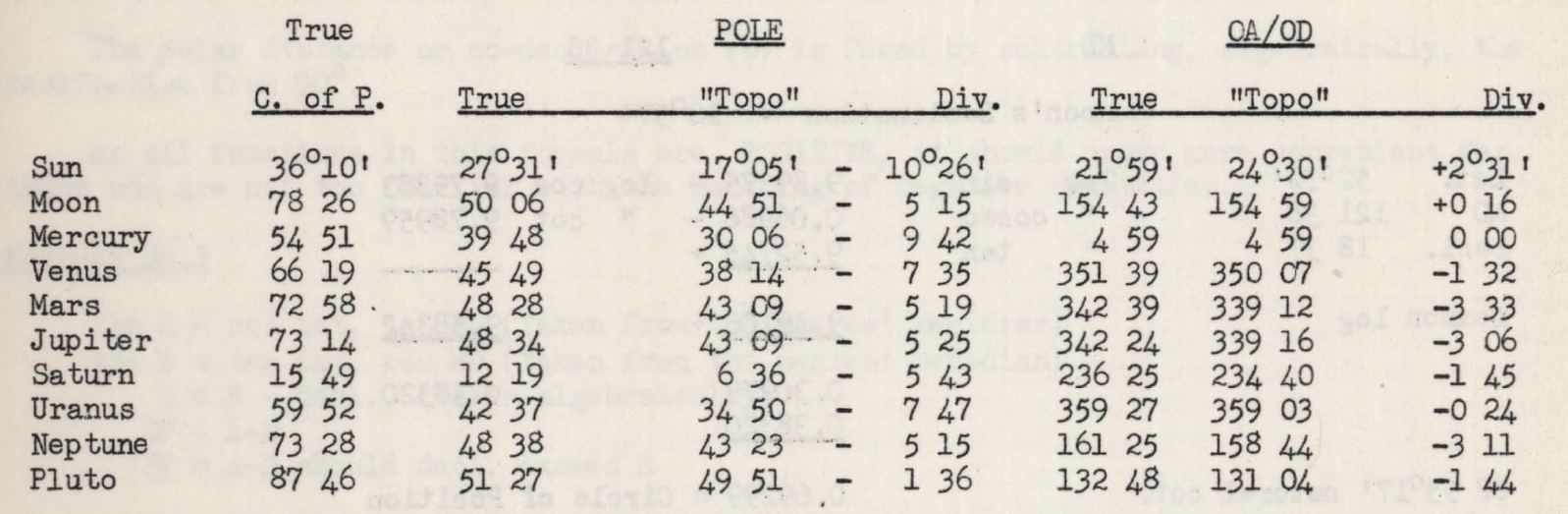
In SPICA, Vol. IV, No. 2 January 1965 (page 5) the authors present a “rectified” version of the geniture of Queen Elizabeth II. It is computed for 1h 12m 41s a.m. GMT on April 21, 1926, for the geographical latitude N 51°31’31”; longitude W 0°07’40”, the RAMC being 226°26’. Included with the chart is a list of OAs and ODs for each of the planets and the log tans of their poles, which are tabulated below as “Topo” Poles and “Topo” OAs and ODs. For comparison, are shown their true equivalents.
Because Mercury declination is only +0°05’, it is almost precisely on the celestial Equator, which is a great circle of the sphere. Hence both its OAs are identical, as should be the case. This but stresses the fact that the “Rule of Three” is only applicable to great circles of the sphere and not to small ones like semiarcs; and, incidentally, that the semiarc system of direction, by proportion of semiarcs is mathematically unsound. Originated by Placido di Titi, its merits were much extolled by “Zadkiel” at the turn of the century.
The circles of position indicate, at sight, the planets’ true mundane longitudes for the “rectified” time of birth. Thus, that of the Sun is 36º 10’; which means that its true mundane longitude is 36º 10’ to the East of the Nadir; or 23º 50’ of the 2nd House (90º–36º 10’ = 53º 50’ below the cusp of the horizon = 23º 50’ of the 2nd House) according to the prime vertical or Campano method of house division (vide The Mundoscope; AFA, Research Bulletin No. 1, 1947).
Spica, 1966, Vol. 5, No. 3, p. 37
Commentary 6: The Law of Diurnal Motion and the Equatorial Conflation
In this passage, Mr. Fagan attempts to use the celestial equator to disprove proportional mathematics, while simultaneously relying upon Campanian dogma (prime vertical) to define the “truth.” He commits two fundamental errors of observation.
A. The misapplication of proportionality
Mr. Fagan declares the Placidean method “unsound” because he has assumed that the “rule of three” (the trisection of the semiarc) is a rigid spatial ruler restricted to great circles. He observes that spatial and temporal measurements perfectly align at the celestial equator and, tragically, mistakes a kinematic coincidence for a universal geometric law. The equator is simply the singular domain where uniform spatial distance perfectly correlates with uniform ascensional time. Mr. Fagan is blind to the fact that the Ptolemaic rule is strictly a measure of proportional time (∆t). He erroneously assumes the rule exacts the partitioning of a great circle into six uniform 30º segments of space.
Because the semiarc is a measurement of time, it is mathematically absurd to claim that one cannot proportionally divide the duration an object spends traveling along a small circle. If a planet on a small circle (possessing northern or southern declination) or the ecliptic point itself takes 15 hours to cross the sky, one-third of its journey is exactly 5 hours. Unable to comprehend this spatiotemporal proportion, Mr. Fagan simply declared the mathematics “unsound.”
B. The solar footprint (empirical reality)
Mr. Fagan attempts to calculate the “true mundane longitude” of the Sun, but explicitly admits that his baseline for truth is defined strictly “according to the prime vertical or Campanus method.” He fails to understand that a zodiacal degree is, necessarily, a function of its specific declination—it is a literal solar footprint. To test the validity of a cusp, one must simply subject it to the Solar Footprint Test: place the Sun at that specific ecliptic degree and observe whether its natural diurnal motion brings it to the prescribed local coordinate.
For example, in the natal chart of Queen Elizabeth II, the Sun sits at 00º Taurus. At precisely 2:40 a.m. on 21 April 1926 in London, that exact coordinate (λ30º) completed exactly one-third of its nocturnal semiarc. Therefore, 00º Taurus is the true, kinematic cusp of the 3rd House—not 12º Taurus as the prime vertical grid dictates, nor any other frame of reference that does not correspond to the natural motion of the sphere (Worsdale, 1819).
C. The anticipated counterargument
The readership might immediately protest:
The answer is an unequivocal no. This accusation would rely upon a false equivalence between a man-made spatial scaffold and an observable physical phenomenon. The Ptolemaic/Placidean method, far from being an arbitrary geometry invented by Ptolemy or Placidus, is the mathematical reflection of diurnal motion (nature) itself. It ensures that all cusps retain the exact same kinematic identity as the Ascendant (Asc) and Midheaven (MC)—they are the pure products of primary motion, representing a seamless synthesis of latitude, declination, and rotation. Campanus is a man-made net thrown over the sky; diurnal motion is the sky itself. Mr. Fagan confused the net for the bird.
The ‘Elements’ of Pluto have been reduced from their rectangular coordinates, computed for the equinox of 1950. Given to the ninth decimal place, corrected for perturbations, these rectangular coordinates have been computed by IBM electronic computers.
Spica, 1966, Vol. 5, No. 3, p. 37
Commentary 7: An Illusion of Precision
In this section, Mr. Fagan attempts to mask a flawed spatial geometry with the illusion of ultimate astronomical precision, appealing to the authority of mid-century supercomputing to validate his architecture.
A. The B1950.0 standard and IBM authority
Mr. Fagan relies on the astronomical standard of his era (B1950.0), the predecessor to the current J2000.0 as a fixed reference point. However, citing a highly precise standard epoch does not validate the mathematical method used to interpret it. Mr. Fagan’s reference to IBM’s early supercomputers (such as the SSEC) appears to be rhetorical tactic. In the 1950s and 1960s, invoking IBM was tantamount to declaring, “This is undeniable and infallible science.” He exploits the computational power to impress the reader, hoping they will confuse raw calculating power with topocentric truth.
B. The GPS and the crayon map
Having Pluto’s coordinates calculated to nine decimal places bears no relationship whatsoever to whether the Campanus or Placidean method of coordinate transformation is correct. Employing the prime vertical for celestial partitioning while consulting the most precise computing technology of the era is the geometric equivalent of buying the world’s most advanced GPS microchip, calculated by quantum supercomputers, but then trying to navigate London using a map drawn with crayons in 1800. It does not matter if your starting position is accurate to nine decimal places; if the geometric framework into which you place it ignores the reality of time (the rate of change across varying diurnal arcs), the entire map is functionally useless.
While there is much that is provocative in this “[Polichian] Series”, for lack of time and space, such must be let pass without comment; but not unnoticed. There is, however, one statement that cannot be let pass unchallenged, because it is so palpably untrue, as even the tyro in “Celestial Mechanics” will confirm.
Concerning the “Transference of the Radix” from the birth place to the place of residence, it is stated: “[…] one establishes the difference between the RAMC of the event and the RAMC of the Radix (always subtracting the latter from the former). This difference must then be added to all OA/OD points of the Radical Houses and planets, and with this the chart for the transference in time and place is accomplished. This chart is, then, directly comparable with the chart of the event […]” (SPICA Vol. IV, No 3, April 1965, p.15).
How can two [tropical] charts, computed in respect of two different equinoxes, be mathematically comparable; seeing that the equinoxes and the solstices are perpetually sliding backwards along the path of the ecliptic at the rate of 1º in about 72 years? This movement [or displacement], which is always negative, is known as precession; but more fittingly, should be termed regression. At the birth of the Queen, April 21, 1926, the longitude of the vernal equinoctial point was Pisces 6º 17’ 38”, and at the death of her father, King George VI, on February 6, 1952, it had retrograded to Pisces 5º 55’ 35”, a difference of 21º 45’ 11”.
Spica, 1966, Vol. 5, No. 3, p. 37
Commentary 8: Precession and the Gregorian Tropical Anchor
In his attempt to champion a sidereal framework, Mr. Fagan exposes a catastrophic ignorance of fundamental coordinate definitions. By lamenting that the equinoxes “slide backwards along the path of the ecliptic,” he misunderstands the geometric reality of the Tropical Zodiac:
A. The tropical anchor (what is actually sliding)
The Tropical Zodiac is not a grid laid over the stars; it represents the measuring tape that lies upon the plane of the ecliptic itself. Its zero-point (00º Aries) is permanently and irrevocably anchored to the Vernal Equinox (Coyne et al., 1983). It always begins there, irrespective of precession.
Because the vernal equinox moves backwards with respect to the background stars, the entire Tropical Zodiac (measuring tape lying upon the ecliptic) moves in unison or simultaneously with precession thanks to the reform of the Julian calendar in 1582, when the Gregorian calendar was instituted (Pope Gregory XIII). If this calendar was specifically designed to absorb or account for precession through a more sophisticated mathematical rule for leap years (compared to that governing the Julian calendar), it cannot then shift relative to itself (to 00° Aries). Never.
B. An intrinsically precessional framework
Our Gregorian calendar is intrinsically ecliptic or tropical, that is to say, it is specifically designed to keep 21 March exactly on the true equinox (based on the Earth’s current specific orientation). Consequently, both the Tropical Zodiac and the Gregorian calendar are intrinsically precessional (Coyne et al., 1983). Therefore, it is more accurate to say that it is the constellations, not the Tropical Zodiac, that slide backwards along our ecliptic.
By ensuring the Equinox as a fixed geometric anchor (00 Aries), we are preserving the integrity of the Diurnal Arc, the very foundation or raw material of the methods of celestial partitioning (which renders the Sidereal Zodiac simply entirely unrelated or nonsensical). Had the Gregorian calendar, and, therefore, the Astronomical Almanac not account for precession (ingeniously preserving the anchor due to the drift), the entire mathematical edifice of house division (which relies upon the intersection of the horizon and the ecliptic itself) would collapse.
C. The independence of natural cusps
An ecliptic longitude of 00º Taurus (λ30º) in 1926 represents the exact same Earth-Sun geometry, the exact same declination, and the exact same ascensional potential as it does in 1952. There is absolutely nothing to “correct.” (It is a profound irony that siderealists are convinced a correction is required, despite failing to honour the true, unequal lengths of the constellations—choosing instead to artificially partition them into 30º segments, mimicking the Earth’s twelve months and/or its seasons, i.e., a Tropical Zodiac).
A cusp—such as the Ascendant (Asc)—is strictly defined as a point of intersection on the ecliptic, entirely independent of the background stars. To demand that one must “precess” a tropical chart in order to compare the topocentric positions of two mundane events is to demonstrate either a total failure to grasp what is actually being measured or that which the Gregorian calendar was called to reflect since 1582.
D. The Earth-Sun geometry
Mr. Fagan is demanding a mathematical correction for a phenomenon that the Tropical Zodiac inherently resolves by its very definition. By attempting to apply a stellar precessional adjustment to a mundane coordinate system, Mr. Fagan decouples the chart from the Earth-Sun geometry that actually dictates diurnal motion. He breaks the kinematics in a misguided attempt to fix a coordinate system that has never been broken since Hipparchus and Ptolemy defined it. The sky has never been broken; only the expectations of some with respect to the place of the stars in the sky were—as was the Julian calendar.
Others, for their part, have clung to the idea that the tropical system must die because Ptolemy’s cosmology is dead, which is like saying that the Pythagorean theorem is “nonsense” because Pythagoras believed beans contained the souls of the dead. Geometry is independent of Ptolemaic beliefs.
E. Fagan’s desire for a stellar anchor
Fagan’s original question, therefore, is a non sequitur (it does not follow). It is the geometric equivalent of asking, “How can two maps be comparable if ‘North’ has shifted slightly over time?” Each map defines North by the Earth’s axis at that specific moment. They remain internally consistent and perfectly comparable because the definition of the zero-point is applied consistently. Mr. Fagan treats the Tropical zodiac as if it were supposed to be fixed to the stars, then criticises it for drifting—which is exactly what it is designed to do without compromising the ecliptic coordinates (thanks to the Gregorian reform).
Fagan is judging a tropical procedure by sidereal expectations and presenting that as a mathematical contradiction. Geometry, however, is independent of his desire for an Earth-stars geometric relationship, that is, for a stellar anchor, as opposed to a solar one.
To render the charts for these two events mathematically comparable, one or other of them must be reduced to the equinox of the other. By adding this “accumulated precession” of 21º ‘45” to all the tropical longitudes of the Radix they are reduced to the equinox of 1952; or by deducting it from the longitudes of all the transits at the time of her father’s death they are reduced to the equinox of 1926. Only when this is done, are the charts comparable.
When so precessed the right ascensions (RA), declinations (decl.), circles of position (CP), poles, O.A, and O.D must be computed ‘ab ova’ and for the place of residence at the time of the event. Surely it must be obvious that these computed for the latitude of London will be totally different to the same computed for the latitude of Nyeri (Kenya), the geographical coordinates of which are S 00º 20’: E 36º 50’ (Fullard: Mercantile Marine Atlas, 1959)!
Adding this accumulated precession to the Radicals expunges it, for, as stated, precession is always negative. On the other hand, sidereal longitudes and latitudes being computed in respect of the equinox of A.D. 221 need no processing. At all times they are immediately comparable.
Spica, 1966, Vol. 5, No. 3, p. 37
Commentary 9: The Astrometric Smokescreen and the Nyeri Strawman
In this passage, Mr. Fagan attempts to mask a fundamental misidentification of what is being measured beneath a smokescreen of astrometric trivia and almanac formatting. He commits two severe epistemological errors by conflating distinct astronomical phenomena:
A. Conflating the mundane and ecliptic spheres
The formula Mr. Fagan quotes concerning the right ascension of the Midheaven (RAMC) and oblique ascension (OA/OD) is an equation of local motion or kinematics; it calculates the topocentric displacement of the sphere based on diurnal motion (the Earth’s daily rotation). Mr. Fagan attacks this by invoking the precession of the equinoxes. This is a severe error. The slow drift of the Vernal Equinox against the background stars cannot invalidate the local kinematic relationship between the RAMC and the horizon (strict Earth-Sun geometry). Mr. Fagan is, once again, bringing a ruler to measure time, or a stellar ruler to measure a temporal phenomenon entirely terrestrial.
B. The Nyeri (Kenya) relocation strawman
Mr. Fagan’s outcry regarding the geographic latitude of Nyeri relies upon a blatant strawman. The very formula he critiques—adjusting the OA/OD points via the RA of the MC (or RAMC)—exists precisely to recalculate the ascension for a new geographic latitude. Mr. Fagan failed to realise that the equation accomplished exactly what he accused the authors of omitting. (As established in our previous commentary concerning the tropical anchor, Mr. Fagan’s blindness here is inextricably linked to his refusal to acknowledge that the tropical/Gregorian framework recognises or computes precession inherently.)
C. The conflation of local space: wallpaper vs. operating system
By confusing the slow wobble of the Earth’s axis (precession) with the daily rotation of the Earth (diurnal motion), Mr. Fagan demonstrates a complete inability to separate deep space from local space. Relocating a chart to Kenya is a topocentric, mundane operation. The background stars are entirely irrelevant to the amount of time a coordinate takes to physically cross the local horizon. Mr. Fagan attacked a flawless local equation because—like the mortals who awaited for the return of the gods—he could not stop looking at the stars (the astrology of the gods, not of men).
Fagan confused the coincidence of an era with the permanence of a law. If the ‘gods’ of the ancient Near East anchored their wisdom to the equinox at a time when the stars aligned, they did so because the equinox represents the biological engine of the Earth. To cling to the stars while the equinox moves is to ignore the very ‘astrology of the colony’ that the gods would have prioritised: the relationship between the Earth and its Sun. Mr. Fagan and his followers have clung to the “background wallpaper” (stars) and ignored the “operating system” (equinoxes/seasons) that any advanced intelligence would have used to manage this world.
With the coming of radar and the vast improvements in electronic devices, [modern] navigators are no longer entirely dependent on the [visual] stars to chart the ship’s course. In consequence, the compilers of nautical almanacs have been freer to cater to the wants of [theoretical] astronomers, pure and simple. To an ever-increasing extent, they [the almanac compilers] are dropping schedules of planets and fixed stars computed for the ‘equinox of date’ [the actual, moving position of the equinox today, which Fagan views as an ‘obsolete’ seasonal reference] for those computed in respect of [fixed] equinoxes for such Besselian dates as 1900 or 1950 [static, frozen reference points]. [This shift has occurred] to the dismay and confusion of the [traditional] astrologer, who has failed to keep pace with the times [and does not realise that ‘true science’ has supposedly abandoned the moving equinox for fixed sidereal snapshots].
Spica, 1966, Vol. 5, No. 3, p. 38
Commentary 10: The Almanac Conflation and the Sidereal Leap
In this final passage, Mr. Fagan attempts to “weaponise” the Nautical Almanac’s use of standard reference epochs (such as Epoch B1950.0) as a tacit endorsement of the Sidereal Zodiac. This constitutes a profound misunderstanding of modern astrometry and reveals a staggering degree of intellectual arrogance.
A. The false endorsement of fixed epochs
Mr. Fagan observes that modern almanacs were “dropping” schedules computed for the equinox of date in favour of fixed Besselian dates (like 1900 or 1950). He leaps to the conclusion that this shift represents an abandonment of the “drifting” tropical framework by mainstream science. In reality, he is mistaking a change in data-entry convenience for a cosmological revolution.
B. The reality of standard epochs
Astronomers freeze coordinate grids at standard epochs purely as a computational convenience. It allows them to map deep-space catalogues without having to recalculate the Earth’s complex nutation and precession on a daily basis. It is an administrative filing system, not a cosmological declaration, and certainly not an invalidation of the kinematic reality of the Tropical Zodiac/Gregorian calendar. To claim that the use of a standard computational epoch proves the superiority of sidereal longitudes is mathematically and historically absurd.
Mr. Fagan is exploiting the technical jargon of the almanac to artificially validate his own sidereal dogma. Because the astronomers were using IBM computers to compute these fixed-epoch (1950) tables, Fagan assumed the result (a fixed sidereal-looking number) was the “New Truth.” He failed to realise that the computers were only using 1950 as a storage folder. He is mocking the astrologer for wanting to be accurate to the second.
C. The misinterpretation of the “drift”
Mr. Fagan catastrophically misinterprets the purpose of Almanac updates. The Almanac is not updated to “correct” a failure in the tropical system, but to maintain the 00º Aries reference point in its rightful kinematic place (correct Earth-Sun geometry) precisely because of the drift. The Tropical/Gregorian system is not blind to precession, as siderealist wish to have believed; it has had it incorporated into its calculation engine from the very beginning (1582).
Fagan points to an astronomer’s administrative filing cabinet and proudly declares it to be the ultimate map of human destiny, mocking the navigator for still wanting to use a working compass. Simply put, Fagan has mocked the watchmaker for checking the time, saying that the modern thing to do is to look at a photo of a watch taken decades ago.
By saying the tropicalist has “failed to keep pace with the times,” Mr. Fagan is committing a logic reversal so massive that it is almost impressive. He has effectively redefined “keeping pace” as “staying frozen in the past.” To find a planet’s actual position tonight, an astronomer must take that fixed 1950 coordinate and apply precession to bring it back to the Equinox of Date (Urban & Seidelmann, 2013). Fagan mocks the astrologer for “failing to keep pace with the times” by wanting today’s coordinates, failing to realise that “keeping pace” with the times is exactly what the Equinox of Date accomplishes (Urban & Seidelmann, 2013). To use a fixed 1950 epoch without updating it is not “modernity”; it is archaeology.
The only person confused was Mr. Fagan, and his arrogance is matched only by his technical confusion.
D. The cost of abdication (or a legacy of unchecked geometry)
By squandering his ink on this sidereal distraction, Mr. Fagan completely abdicated his responsibility as a mathematical critic. Blinded by his crusade against the Tropical Zodiac, he failed to audit the actual geometry being presented to him. His failure to adequately dismantle the Polichian mechanics allowed the greatest geometric hoax in astrological history—Polich’s eccentric cones—to pass unchecked, granting a defective system an unearned legitimacy that continues to plague the astrological practices of Argentina and other parts of the world to this day.
In the American Ephemeris and Nautical Almanac for 1965 (p. 256) the RA and declination of Pluto for January 0, 1965 (i.e. December 31, 1964), 0 hrs, Ephemeris time, are listed as 11h; 32m: 01.043s and + 18 38’45 11 respectively. But, alas, for the astrologer these have been computed for the equinox of 1950. To reduce them to the equinox of date (January 0, 1965) he will have to “precess” them by the corrections given in Table IV, page 457 of the same Ephemeris.
Why have the compilers of the almanac done this? Simply because the magnitude of Pluto, varying from 12 to 15 renders it invisible in ships’ telescopes, and hence of no use to navigators. So, Pluto’s ephemeris is for the benefit of astronomers only; who need a sidereal zodiac to make precision comparisons; and in computing for, say, the equinox of 1950, and not that of date! they have converted the tropical zodiac for this year into a quasi-fixed one!
The RAs and declinations of any new stars that are discovered are immediately reduced to the equinox of 1950 and the exhaustive star lists compiled for that equinox are searched to see if the star can be identified; which would not be practical should the RA and Decl. of the star be not so reduced.
Spica, 1966, Vol. 5, No. 3, p. 38
Commentary 11: The Echo Chamber of Debunked Premises
In this concluding passage, Mr. Fagan offers no new evidence. Instead, he simply recycles the category errors that have crippled his entire critique. Rather than reproducing our full geometric teardowns, we direct the reader to the specific forensic principles established earlier in this analysis:
A. The echo of precession
Mr. Fagan once again insists that tropical charts must be precessed in order to yield valid mundane coordinates. As detailed in our commentary regarding the tropical anchor (Commentary 8), this ignores the geometric nature of the ecliptic. The Tropical Zodiac is intrinsically precessional, that is, it absorbs the Earth’s wobble by definition (Coyne et al., 1983). To artificially “correct” it with a stellar shift is to mathematically sever the chart from the exact Earth-Sun relationship that governs local ascension.
B. The echo of the almanacs
Mr. Fagan leans upon the Nautical Almanac for a final appeal to authority. As established in our previous commentary, standard reference epochs (e.g. B1950.0) are an administrative computational filing system designed for deep-space mapping. They are not a cosmological validation of the Sidereal Zodiac, nor do they invalidate the seasonal nature of the tropical framework.
Some “critics” claim that the Almanac’s update of coordinates is merely a ‘convention’ and not a ‘seasonal doctrine.’ This is a distinction born of technical blindness. A ‘convention’ that anchors its entire coordinate grid to the True Equinox of Date is a convention that has surrendered to the tropical reality. The Almanac does not preserve 00º Aries because of ‘folklore’; it preserves it because it is the only zero-point that maintains kinematic integrity for an observer on Earth. Fagan mistook the administrative shift for a spiritual betrayal, failing to realise that the astronomers were simply perfecting the very tropical anchor whose death he appeared to have sought (at the expense of an accurate critique of the Polich method).
C. The collapse of the Euclidean birdcage
Stripped of its maritime jargon, irrelevant spherical trigonometry, and namedropping of IBM supercomputers, Mr. Fagan’s critique is revealed for what it truly is: the desperate attempt of a Euclidean thinker to outlaw the measurement of kinematics. He did not disprove the differentiated proportional kinematics of Ptolemy/Placidus; he merely proved that he did not possess the astronomical understanding to assess them.
* * *
In Part II of this series, we will examine the devastating fallout. First, we will analyse the poisoned well of their “empirical” foundation: the philosophical absurdity of reducing human life events—fluid processes with distinct beginnings, climaxes, and resolutions—into microscopic, instantaneous mathematical points. It frankly does not matter which coordinate or partitioning system is employed to map a human event if the practitioner fundamentally misunderstands the event itself, which constitutes a broader window of time (as modern medicine, psychiatry, and developmental psychology understands them). At best, their initial Placidian mathematical premise could have only ever confirmed such a window; it could never pinpoint a singular micro-second with respect to a human event.
By forcing fluid human realities into rigid mathematical coordinates, Polich and Page engineered a system that was theoretically bankrupt long before they ever attempted to disguise their Placidian imitation with eccentric cones. Next, we will analyse how they felt compelled to justify this flawed empirical foundation with a rigid spatial architecture. In doing so, they abandoned kinematic purity and introduced to the world (Spica, 1964) a geometric absurdity entirely of their own making: the imaginary, eccentric cones (Casey, 1889) of the presupposed Topocentric System.
References
Bowditch, N. (1868). The American practical navigator: An epitome of navigation and nautical astronomy. Government Printing Office.
Casey, J. (1889). A treatise on spherical trigonometry: And its application to geodesy and astronomy, with numerous examples. Hodges, Figgis, & Co.
Cotter, C. H. (1968). A history of the navigator’s circle of position. Brown, Son & Ferguson.
Coyne, G. V., Hoskin, M. A., & Pedersen, O. (Eds.). (1983). Gregorian reform of the calendar: Proceedings of the Vatican conference to commemorate its 400th anniversary, 1582-1982. Specola Vaticana.
Lenart, I. (2003). Non-Euclidean adventures on the Lenart Sphere. Key Curriculum Press.
Meeus, J. (1998). Astronomical algorithms (2nd ed.). Willmann-Bell.
Michelsen, N. F. (2009). The Michelsen book of tables. ACS Publications.
Placidus de Titis. (1657). Physiomathematica sive coelestis philosophia [Physiomathematics or celestial philosophy]. (Original work published 1650).
Placidus de Titis. (1814). Primum Mobile (J. Cooper, Trans.). Davis and Dickson. (Original work published 1657).
Ptolemy, C. (1940). Tetrabiblos (F. E. Robbins, Trans.). Harvard University Press. (Original work published ca. 2nd century CE).
Rochberg, F. (2004). The heavenly writing: Divination, horoscopy, and astronomy in Mesopotamian culture. Cambridge University Press.
Thompson, S. P. (1910). Calculus made easy. Macmillan and Co.
Todhunter, I. (1886). Spherical trigonometry: For the use of colleges and schools (5th ed.). Macmillan and Co.
Urban, S. E., & Seidelmann, P. K. (Eds.). (2013). Explanatory supplement to the astronomical almanac (3rd ed.). University Science Books.
Worsdale, J. (2010). Celestial philosophy, or genethliacal astronomy. Kessinger Publishing.
__________________________
Download the archival document herein.