Physical Address
The Woodlands, TX, USA
Physical Address
The Woodlands, TX, USA

To my dear son, Mateo
A prevailing deficiency in modern mathematical pedagogy is the presentation of calculus in direct opposition to its historical and kinematic genesis. Too often, students are introduced to static algebraic formulations and inert rule sets long before they are permitted to observe the physical mechanics of continuous motion. This epistemological disconnect was notably addressed by Morris Kline. Although originally trained in abstract topology under James W. Alexander, Kline reoriented his focus toward differential equations and applied mathematics.
This pivot was largely influenced by Richard Courant, who posited that the highest utility of mathematics lies in elucidating the physical world. There is a profound irony in Courant, a master of pure formal rigor, persuading Kline to abandon abstract topology; yet, Courant acutely recognised that mathematics forfeits its foundational utility when completely decoupled from physical reality.
Morris Kline, in turn, observed (1977):
A thoroughly sound, deductive approach to the calculus, one which the modern mathematician would regard as logically rigorous, is meaningless before one understands the ideas and the purposes to which they are put. One should always try to understand new concepts and theorems in an intuitive manner before studying a formal and rigorous presentation of them. The logical version may dispose of any lingering doubts and may be aesthetically more satisfying to some minds, but it is not the road to understanding.
Calculus: An Intuitive and Physical Approach
p. 6, Dover Publications
The limitations of an inert geometry
When this philosophy of applied mathematics is directed toward the historical study of celestial mechanics, the inadequacies of traditional geometric tools become glaringly apparent. Consequently, the standard formulas of spherical trigonometry inherently fail to satisfy rigorous intellectual inquiry because they cannot explicitly model a continuous trajectory. Instead, they capture a frozen snapshot of a spatial phenomenon, treating topocentric celestial coordinate systems as though they were as inert as the prime vertical of Campanus of Novara (1120-1296) or the celestial equator of Regiomontanus (1436-1476).
Attempting to force the continuous kinematic journey of a diurnal arc into a static, two-dimensional snapshot necessitates mathematical concessions (e.g. circles of position) that are fundamentally flawed. For example, utilising circles of position—drawn from the north to the south point of the horizon—to map a celestial object essentially projects its coordinate onto a standardised spatial grid, such as the prime vertical. By doing so, this geometry treats the object’s kinematic journey as if it were tethered to the due-East ascending mechanics of the celestial equator, inherently ignoring the object’s true declination and oblique rising azimuth.[1]
Measuring along this static circle of position fails to reflect the exact temporal duration ( ) after rise required for that unique coordinate to attain a specific altitude and azimuth within the local sky (latitude).
The kinematic mandate
Kline’s overarching philosophy asserts that calculus must remain inextricably linked to the dynamic physical environment. Thus, a robust comprehension of physical motion must precede abstract analysis. Diverging from the rigid formalism of the traditional German school of mathematical analysis—which often prioritised dry proofs disconnected from astronomical mechanics—Kline anchors his methodology in motion, velocity, and dynamic geometric trajectories. Because contemporary rigorous analyses of the local sky must prioritise physical realism and kinetic trajectories over abstract numerical manipulation, Kline’s framework provides the precise conceptual lexicon required to model how celestial coordinates continuously sweep across a topocentric manifold.
Furthermore, because the obliquity of the ecliptic perpetually alters the declination of longitudinal—tropical zodiacal—degrees as they traverse the local horizon, treating the celestial sphere as a uniform, static grid constitutes a physical impossibility. The rigorous observer is invariably navigating a continuous family of curves. (See simulations)
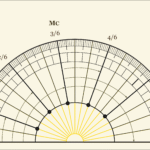
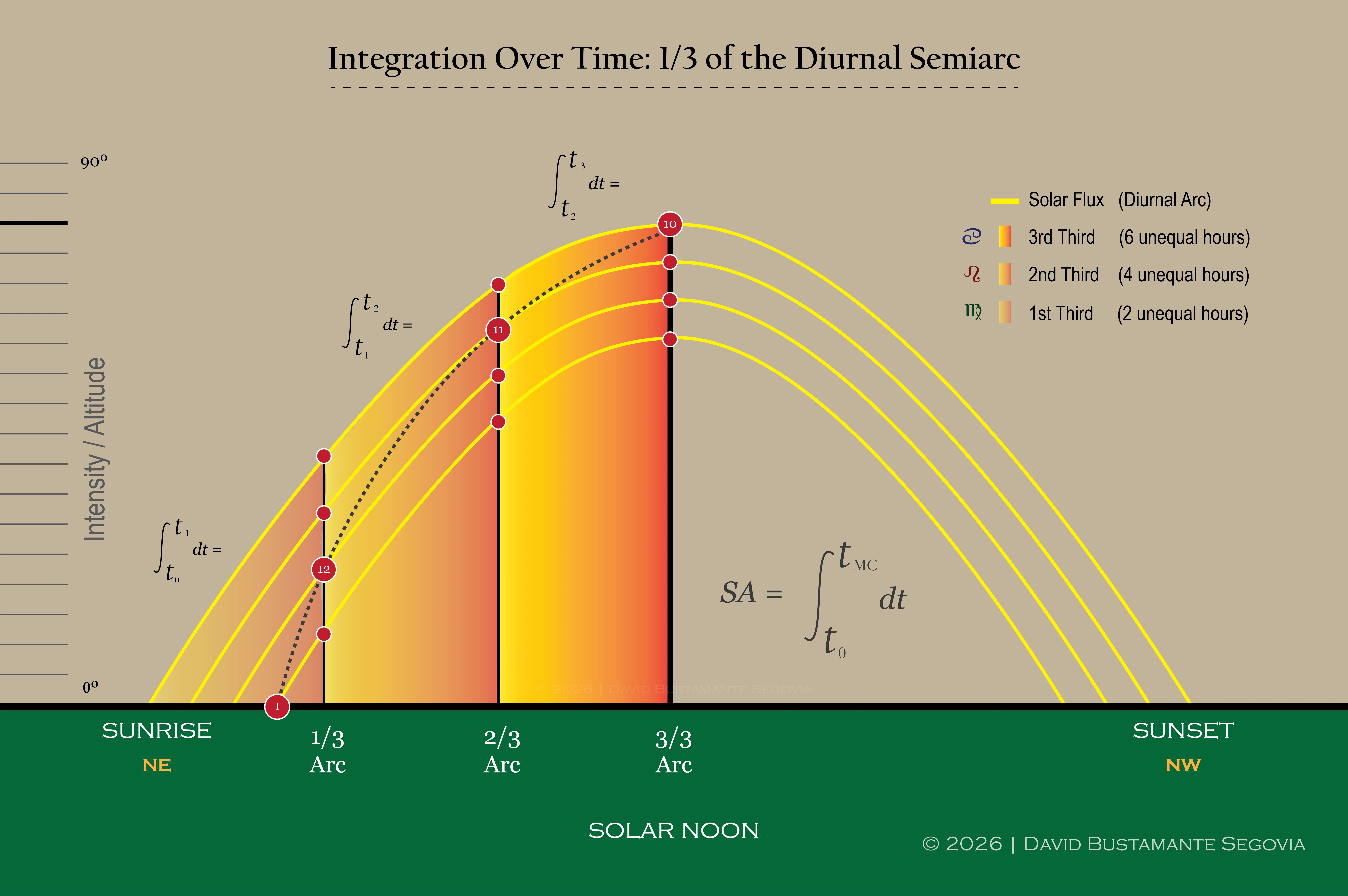
To determine precisely which ecliptic coordinate has completed an exact fraction (e.g., one-sixth) of its unique diurnal semiarc at any instantaneous moment, one must interrogate the state of a differential system. Differential calculus systematically rejects the artifice of flat spatial projections. Instead, it necessitates tracking the literal, kinematic transit of a coordinate relative to the observer’s topocentric horizon—specifically measuring the simultaneous rates of change in both altitude and azimuth ( and
and  ) as the coordinate continuously fluctuates across fractional isophasal boundaries (“cusps”).
The historical fracture
When Placidus de Titis formalised his system of celestial partitioning, his methodology was severely constrained by the chronological limitations of his era. He could not employ differential calculus to map the continuous paths required to identify distinct ecliptic coordinates—and their varying declinations—that have achieved identical proportional stages of their diurnal or nocturnal arcs, simply because the mathematical apparatus had not yet been fully realised.
Consequently, Placidus was confined to the archaic trigonometric tools inherited from Ptolemaic and medieval Islamic traditions. Nevertheless, that he successfully codified these proportional boundaries using only manual geometric iterations—entirely devoid of modern programmatic engines or the Newton-Raphson method—stands as a monumental feat of mathematical endurance.
During the intervening centuries, as the institutional schism between astronomy and astrology widened, the astrological community did not integrate the language of calculus until well into the twentieth century. Having largely abandoned the pursuit of kinematic mathematics in favour of the uncritical repetition of static algebraic procedures and pre-calculated ephemerides, the community fostered a profound epistemological misunderstanding.
Modern practitioners erroneously came to define methods of celestial partitioning—and the cusps they produce—strictly as the rigid spatial products of great circles, entirely ignoring their true temporal curvature and, consequently, their precise topocentric coordinates.
Conclusion
An enduring epistemological schism exists because scholars with a profound mastery of continuous mechanics rarely investigated the underlying structures of astrological methods of coordinate transformation (house division), whilst the practitioners analysing these divisions lacked the mathematical fluency requisite for differential calculus. As a result, the Ptolemaic/Placidian method has remained conceptually entombed in the seventeenth-century vernacular of spherical trigonometry.[2]
This has led to a profound modern irony: contemporary astrological software engines now silently execute complex numerical approximations, such as Newton-Raphson iterations, to accurately map a kinematic reality that the community itself has long forgotten how to visualise organically.
* * *
Find herein a guide to confirm the topocentric integrity of any method of celestial partitioning
__________________________
[1] By projecting an object’s position along a great circle drawn through the North and South points of the horizon, the geometry anchors the object to a spatial grid fundamentally aligned with the East and West points. Because the celestial equator is the only diurnal path that inherently rises exactly due East, sets exactly due West, and yields a perfectly symmetrical time-of-flight across the sky, treating these equal spatial wedges as equal blocks of time forces the object to obey equatorial mechanics. The mathematical projection essentially “assumes” the object has a declination of 0º. Therefore, it completely ignores the object’s actual declination. It calculates the elapsed time () as if the object were traveling along the equator, utterly failing to account for the fact that an object with true northern or southern declination rises at an oblique azimuth and requires a vastly different temporal duration to reach that exact same altitude and azimuth in the local sky after having risen.
[2] It is necessary to distinguish the ontological definition of these proportional boundaries (with respect to the verying sizes of the diurnal arcs) from the computational algorithms utilised to locate them. Whilst the true nature of Placidian divisions is most elegantly set forth by definite integrals mapping time over the diurnal semiarc, locating the exact ecliptic longitudes or degrees that satisfy these integrals fundamentally requires spherical trigonometry. Modern programmatic search engines do not discard this geometry; rather, they bypass the laborious manual iterations of the past by deploying advanced numerical approximations, such as the Newton-Raphson method, to converge upon the correct coordinates with optimal efficiency.