Physical Address
The Woodlands, TX, USA
Physical Address
The Woodlands, TX, USA
This article was originally published by The Urania Trust
One of the arguments most unfortunate in the history of celestial partitioning—or methods of house division—rests upon a logical fallacy: justifying a mathematical method based solely upon the authority of a single individual. That method is the equatorial approach of Regiomontanus (15th century), recently empirically confirmed to be unsuitable for the calculation of cusps at oblique horizons [i], along with other linear methodologies. [ii] The common refrain is as follows: “Lilly used it. Therefore, it is the best method for horary work”—or even natal work. This appeal to authority invokes, consequently, the brilliant 17th-century master of horary astrology, William Lilly (1602–1681).
Before quoting the great master in full (who confessed to using the equatorial method because calculating the varying lengths of every diurnal arc of every cuspal degree is extremely “laborious,” III, p. 651), it is necessary to clarify that the popular simplification referenced above conflates two fundamentally different concepts: the performer’s performance (talent) and the integrity of the instrument (tool). Expounded simply, it ignores a critical distinction: talent vs. instrument.
1. First Things First: Talent vs. Instrument
To understand this distinction, it is necessary to separate the art of interpretation from the science of measurement. Astrology (interpretation or celestial inference) is not an exact science; only its tools (astronomy, mathematics) are. In this sense, the skill of a practitioner does not validate the geometric integrity of the instrument. We can illustrate this pedagogically by means of an analogy:
A highly talented surgeon can make a precise incision with an unsuitable instrument, whereas an untalented surgeon can make an imprecise incision with a suitable instrument, as they are limited by their skill or aptitude, not by the tool, just as, conversely, the surgeon’s talent can reduce the risk of an imprecise incision with an unsuitable tool. Only a completely unsuitable tool, e.g., a stick instead of a cutting object, could compromise human performance altogether.
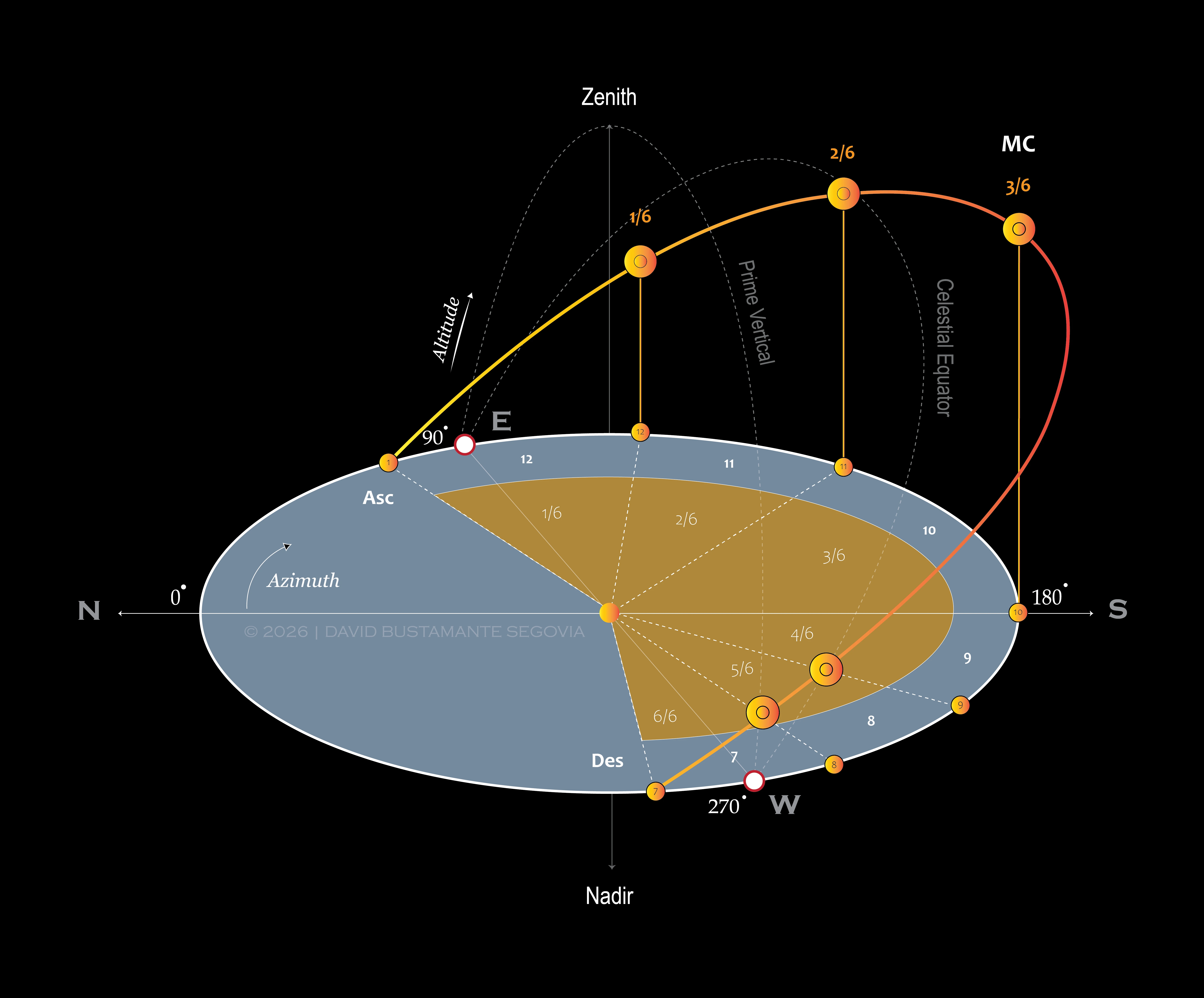
William Lilly was one such talented surgeon, as was, too, Morin de Villefranche. One may only conjecture without certainty which of the two had a clearer understanding of the necessity for capturing every diurnal arc at a precise moment (i.e. of following primary motion discriminately). Lilly’s unparalleled ability to interpret the heavens allowed him to overcome the geometric imperfections that he himself explicitly recognised as a drawback to the method he employed. Subsequent reliance upon his technical precedent constitutes merely a genuflection to authority that ignores the fundamental question: was the tool, itself (i.e., the celestial equator or the prime vertical as the primary frame of reference through which great circles [iii] drawn from the north/south points would pass in order to meet the ecliptic/cuspal degrees), suitable?
2. Lilly’s Own Words, or His Geometric Handcuffs
As one reads the historical document in question responsibly, documentary analysis provides the definitive answer. Lilly, in Book III of Christian Astrology (1647/2004, p. 651), warns:
____________________________
[i] Latitudes wherein the sun and the ecliptic rise considerably north of due east and set north of due west during the summer, or south of due east and west during the winter.
[ii] The prime vertical method (Campanus of Novara, 13th century) is a quintessential linear calculation of house cusps. Because cusps are inherently ecliptic points, they must be defined by the ecliptic’s own geometry; utilizing foreign frames of reference inevitably yields mathematically non-exact results. (For a quantitative comparison, see Bustamante, “Astronomical Fidelity,” PhilArchive, 2025). Similarly, the methods of Alcabitius and Koch constitute variations of linear partitioning that artificially uniform ascensional times. By assigning the specific ascensional time of the Ascendant (Alcabitius) or of the Midheaven (Koch) to the intermediate cusps, these imply that disparate points of the ecliptic share an identical time of rising/culmination. Outside of the unique conditions of the polar regions—where the ecliptic rises parallel to the horizon—such a sharing of ascensional times is physically and geometrically impossible.
[iii] In the geometric derivations of Campanus (prime vertical) and Regiomontanus (celestial equator), great circles are projected from the North and South points of the local horizon in order to have them pass or intersect the designated great circle. These intersections are then projected onto the ecliptic to determine the cusps. This procedural exercise, however, results in cusps whose linear derivation are not linearly proportional to their actual times of ascension (amount of time required for them to attain or occupy said azimuth and altitude upon the horizon). By imposing a fixed spatial grid, these methodologies ignore the specific declination of each zodiacal degree (i.e. ecliptic coordinate), effectively decoupling the ‘houses’ from the real-time, kinematic, or non-linear motion of the local horizon (i.e., frozen grids rather than living arcs).
Continue reading this piece at The Urania Trust:
https://www.uraniatrust.org/academic/lillys-geometric-handcuffs