Physical Address
The Woodlands, TX, USA
Physical Address
The Woodlands, TX, USA
The success of certain specialists (e.g., Anthony Louis, Juan Estadella) with the most rigorous traditional forecasting techniques of celestial inference confirms the necessity of the temporal precision advocated by figures such as Lilly, Morin, and Placidus, amongst others.
Historical methodological context
The most prominent astrologer in England and a preeminent figure of the seventeenth century, William Lilly, explained:
[…] and although many times it pleases God that we do not hit the mark […] I impute the errour not to the Art, but to the idleness or insufficiency of the Artist, who not rectifying the Nativity exactly before he framed his Directions, does in his annual judgment (Errare toto Caelo), for indeed it is the most difficult learning of all Astrologie, to verify the ascendant [point] […] if we fail two or three degrees […] then, I say, the Accidents signified thereby must come so many years sooner or later […]
Lilly, III, 1647/2004, p. 652
Gansten, for his part, emphasises a reflection by Morin de Villefranche. In fact, the author devotes a section of the book (“Limitations in timing”) to addressing this matter.
[…] sometimes, contemporary astrologers interested in primary directions claim to systematically achieve accurate dates that correspond to the week or day of an event. These claims may sound impressive, but they do not stand up to scrutiny. The observation made by Morin more than 350 years ago therefore remains valid:
Gansten, Primary Directions, 2009, p. 75
Gansten proceeds with said quote from Morin de Villefranche:
[…] And experience proves that […] the accident (i.e., event) sometimes comes before the precise time of the direction [i.e. time of arrival] and sometimes follows it; not by one day only, or one month, but even by several, or rather now and then throughout the year, although this happens more rarely; and this [can happen with] whatever may be taken as the measure of the arc and however the aspects of the planets are corrected (for latitude). For there is no nativity in which the effects of all the directions correspond exactly in time to their arcs; and very frequently it happens that if in any nativity two or three such directions [i.e. events signified by the times of arrival] are seen, the rest will in fact be found to precede or follow [the time of arrival], more or less.
Morin, XXII, 1661/2005, p. 64, trans. Holden
The above quotations confirm what most topocentric practitioners have verified for themselves during their technical training or, at least, suspected: the interpretative exercise constitutes the non-exact component of the discipline, whereas the primary directions or the calculation of the time of arrival of a celestial object (specific degree of the ecliptic or a body occupying it) at a given point on the local horizon, in turn, constitutes the exact component of the discipline. The professional decides which arrival time (unequivocal based on diurnal motion) would represent which event. If this event occurs within a reasonable time frame before or after the time of arrival (direction), it is legitimate to argue that the interpretation of the direction (i.e. time of arrival of a certain object to a certain place) was correct.
The necessity of temporal precision
Primary directions are the traditional forecasting technique most sensitive to time and, by extension, to the accuracy of all house cusps, be these angular or non-angular (i.e., ‘a cusp is a cusp,’ whether it constitutes an angle or a subangle). They are based upon the principle that the apparent movement of the sky in the hours after birth represents the events of life. Lilly defined directions as follows:
[…] Since the Art of Direction consists solely in ascertaining in what space of time the Signifier [a particular celestial body or object] will meet its Promiser [another body], or in clearer terms, when, at what moment, in what year such and such an accident will happen [i.e., an event believed to have been signified or represented by that conjunction].
Lilly, III, p. 651
The dependence upon the time of ascension
In order for a primary direction to be fulfilled with the accuracy of an arc minute (e.g., when a celestial body reaches the local meridian/MC), the basis for calculating the cusp, angular or otherwise, must first have been impeccable, that is to say, unequivocal. A recent computational finding (discrepancies in arrival times) shows that the methods that standardise ascensional times (Alcabitius, Campanus, Regiomontanus, Koch) introduce (each in a different way) a cumulative systematic inaccuracy concerning the intermediate cusps, which becomes noticeable at the more oblique latitudes (35º N/S and above).
The phenomenon responsible of the arrival time of a point of the ecliptic at a given place upon the horizon is known as diurnal or primary motion, and it is what defines which points of the ecliptic have covered or travelled a certain amount of time to become the cusp of the twelfth (12), eleventh (11), tenth (10), or any other (9, 8, 7, 6, 5, 4, 3, 2, 1) house.
Resorting to this technique after having originally used a form of calculation unrelated to it (i.e., a form of calculation that falsifies diurnal motion) constitutes a contradictory methodological procedure or exercise. Should we become concerned with the time of arrival of an object at a certain point upon the horizon, will we attribute to said object a fictitious ascensional or displacement rate by use of a frame of reference that is foreign to the point of the ecliptic it occupies (e.g., circles of position dependent upon an equipartite segmentation of the celestial equator or of the prime vertical)? This can be likened or is analogous to deciding to use the same engine to measure speed without adhering to the resulting measurement from the odometer.
Shortly after the eighteenth century, the critical connection was forgotten or often overlooked that the time of arrival of a zodiacal point at the local meridian (MC), as well as that of another at the eastern horizon (ASC), is caused by the same phenomenon, diurnal motion, only that the intermediate points between the plane of the horizon (where the ASC lies) and the local meridian (where the MC lies) do not enjoy physical frames of reference by or through which we can discern which point of the ecliptic has completed one-sixth of its own diurnal arc (which corresponds to a different circle of declination), for the philosophical postulate requires the partitioning of the local sky into six equal segments.
Analysis of the quote from Gansten (2009) and M.J. Makransky (1995)
Martin Gansten and M.J. Makransky, therefore, incurred a conceptual inaccuracy (2009, 1995) when having maintained:
There is no compelling reason to suit one’s method of primary directions to a particular system of house division or vice versa.
Gansten, Primary Directions, 2009, p. 56
I don’t believe that there is a valid method of directing planets to one another, no matter how appealing that idea might seem. The only valid primary directions are those to the angles.
Makransky, Primary Directions/Primer for Beginners, 1995, p. 4 (from the article itself)
The sole engine which drives the houses is the Earth’s diurnal rotation (the daily apparent movement of the ecliptic). This physical rotation is the single, non-negotiable, observable reality or phenomenon that determines all positions, that is, that produces both the angular axes or cusps (ASC, MC) and the intermediate cusps or subaxes. They are distinguished solely by the moment at which the fraction of their arc is measured. If the ASC is the degree which cuts the horizon at that moment (time 0), the cusp of the twelfth house is then the degree that would have cut the horizon had we gone back in time one-sixth of the duration of that house. Both positions constitute ‘time markers’ (Houlding, 1995/2003) along the same path of rotation. Separating them, therefore, lacks logical, physical, or geometric basis, the sole explanation resting upon the avoidance of the complexity of a simultaneously uninterrupted calculation (which explains the use of the celestial equator in the case of Regiomontanus, or of the prime vertical in the case of Campano; and of a single circle of declination/diurnal arc in the case of Alcabitius and Koch).
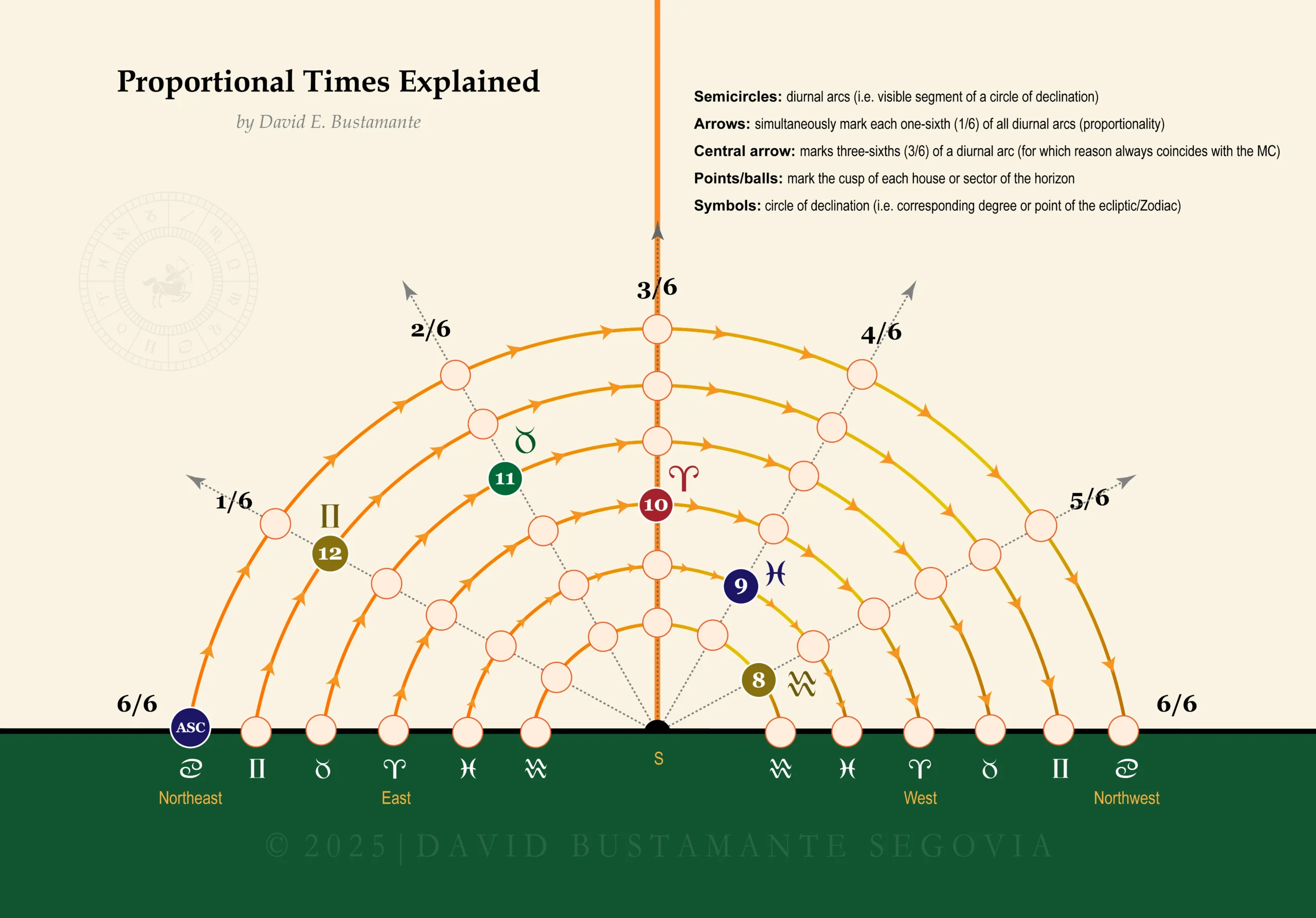
The claims of Gansten and Makransky (2009, 1995) do not account for the fact that the intermediate cusps, like the angles, are essentially ‘time markers’ (Houlding, p. 104) in the uninterrupted process of diurnal motion. The difference is basic, but it requires the astrologer to understand the mechanism of action of a celestial chart. The diagram is not a static spatial reflection of twelve cusps, but a three-dimensional model of diurnal motion.
Both arguments, therefore, are possible only when one has ignored or forgotten that every cusp (time of arrival) has a single phenomenological author: diurnal motion. Whether the cusp is angular or non-angular is not relevant, as it bears no relationship with the foundational postulate according to which it is necessary to determine the time of arrival of a given zodiacal degree (ecliptic point) at a given place upon the horizon.
The difficulty in recognising the phenomenological unity rests upon the separation between calculation and interpretation. That is, the interpretation of a time of arrival (e.g., publication of a book because Mercury has caught up with Jupiter or travelled the same amount of time as Jupiter on the local horizon in accordance with its own diurnal arc), unlike the calculation of the time of arrival itself (e.g. when Mercury catches up with Jupiter), tends to blur, disguise, or conceal the necessity of temporal precision. (See our Declaration of Research Methodology: The Primacy of Forensic Geometry.)
Celestial inference (astrology), however, is not an exact science, unlike its tools (astronomy, physics, spherical trigonometry). If it is not, how necessary can the precision of the cusp itself upon the basis of which we establish a directional exercise be, therefore? Shall the physician proceed with the interpretation of a diagnostic image knowing the instrument that produced it contains a mechanical defect?
Conclusion
Angles (i.e., angular cusps) have always held priority from a symbolic standpoint (i.e., what does a particular local astronomical event represent?). The error, however, lies in prioritising the symbol while rendering secondary the mechanism of action that explains or determines the time of arrival that is said to represent the event, thereby divorcing it from the observable phenomenon or physical law that governs the production of the angles. Should a direction upon an angular cusp be considered valid, the direction upon a subangular cusp (calculated correctly, that is, in accord with the proportion of its arc) must, by logical and epistemological necessity, be equally valid. This, however, is to not be taken to imply that the position of the sun between sunrise and noon represents the same intensity of light energy as at exactly noon. The subsequent consequences for flora and fauna, as well as for human metabolism, are a separate matter.
As a method of celestial partitioning (house division) is based upon ‘rising times’ (Ezra, 2014, trans. Shlomo Sela), it is not disconnected nor can it claim to be disconnected from the method of primary directions (the relationship is indissoluble). Expounded simply, it cannot claim to discard the intermediate cusps, for they are points of arrival produced by the same phenomenon.
References
Bennett, J. A. (1988). The divided circle: A history of instruments for astronomy, navigation and surveying. Phaidon Inc Ltd.
Bustamante, D. (2025). The astronomical fidelity of celestial partition coordinate systems. Quantitative comparison of linear vs. non-linear methodologies. Philpapers. https://philpapers.org/rec/BUSLFA
Bustamante, D. (2024). The mechanism of action of the non-geometrical method Placidus. DOI 10.5281/zenodo.14452567. https://zenodo.org/records/14452568
Chatham, R. (2021). Placidus versus Alcabitius house system. Personal research blog of Rhys Redmond Chatham. https://rhysastrology.fr/placidus-vs-alcabitius/
Ezra, Abraham Ibn. (2014). Nativities and Continuous Horoscopy: A Parallel Hebrew-English Critical Edition of the Book of Nativities and the Book of Revolutions. Trans. Shlomo Sela. Brill.
Gansten, M. (2009). Primary directions: Astrology’s old master technique. The Wessex Astrologer.
Holden, R. W. (2023). The elements of house division. Raven Dreams Press. (Original work published 1957)
Houlding, D. (2003). The problem of house division. Skyscript. https://www.skyscript.co.uk/houprob.html (Original work published in 1995.)
Houlding, D. Planetary hours (and days). Skyscript. Retrieved from https://www.skyscript.co.uk/glossary/planetary-hours/
Lilly, W. (2005). Christian Astrology. Book Three. Astrology Classics. (Original work published in 1647.)
Louis, A. (2022).
Primary directions: Placidus vs Regiomontanus [Comparative analysis of historical domification and predictive temporal fidelity]. Personal research blog of Anthony Louis. https://tonylouis.wordpress.com/2022/11/26/primary-directions-placidus-vs-regiomontanus/
Louis, A. (2022). Spacetime and astrological house systems [Scientific basis of celestial partitioning]. Personal research blog of Anthony Louis. https://tonylouis.wordpress.com/2022/12/28/space-time-and-astrological-house-systems/
Louis, A. (2025). Primary directions and President’s Trump forecast [Empirical analysis of discrepancies]. Personal research blog of Anthony Louis. https://tonylouis.wordpress.com/2025/06/28/primary-directions-and-president-trumps-forecast/
Ludwig, O. A. (1930). Ein Beitrag zum Hauserproblem [A Contribution to the House Problem]. Zenit. Zentralblatt für Astrologische Forschung, (6), 169–221.
Makransky, Bob. (2022). Primary directions. Dear Brutus Press.
Michelsen, N. F. (2009). The Michelsen book of tables. ACS Publications.
Morin de Villefranche, Jean-Baptiste. (2008). Astrologia Gallica. Book 17: The Astrological Houses. American Federation of Astrologers.
Müller, J. (1967). On triangles. University of Wisconsin Press. (Original work published in 1533/1561.)
Placidus de Titis. (1814). Primum mobile (J. Cooper, Trans.). Davis and Dickson. (Original work published 1647)
Powell, R. (1996). History of the houses. ACS Publications.
Ptolemy. (1940). Tetrabiblos (F. E. Robbins, Trans.). Harvard University Press (Loeb Classical Library). (Original work published ca. 150)
Shank, M. H. (1998). Regiomontanus and homocentric astronomy. Journal for the History of Astronomy, 29(2), 157–187. https://doi.org/10.1177/002182869802900208
Wackford, M. (1994). Placidus and the semiarc method of house division. The Traditional Astrologer Magazine, 7.
Wackford, M. (2002). The polar arcs. Correlation, 21(1), 14–21. https://skyscript.co.uk/polar3.html
Wackford, M. (2008). It’s the Oblique Sphere, Stupid. Skyscript. https://mail.skyscript.co.uk/polar_oblique.html
Appendix: Commentary on the practise of Louis and Estadella
Anthony Louis LaBruzza
Due to the primary directions being a technique of precision concerning the time of ascension, for a prediction to work with the required astronomical fidelity, as Anthony Louis advocates in Fast and Easy Primary Directions and, especially, in A Useful Astronomical Site, we depend, de facto, upon a celestial chart whose calculation respects the temporal proportion of each circle of declination responsible of each diurnal arc of interest (Ptolemaic, Placidian, or natural principle).
Arrival times are not determined by a particular method of house division or any ‘circle of position’, but by nature, i.e. latitude, time, and date. The only method capable of reflecting this from cusp to cusp or from celestial object to celestial object (as it is not dependent upon frames of reference foreign to the relationship of the ecliptic directly to the local horizon) is the method of diurnal motion (Ptolemaic), since it is the sole method that does not discern between space and time; it is intrinsically spatiotemporal.
Anthony Louis, professor of primary directions at Kepler College, explores and explains the subject in this video, The Power of Primary Directions. The same author (Louis) explored (as we did in 26 September 2024) the compatibility of the topocentric calculation in question with Albert Einstein’s theory of general relativity, albeit not in the realm of quantum physics, but classical physics. In December 2022, he wrote about the indissolubility of time and space from the point of view of house systems. See Spacetime and Astrological Systems of Houses.
Juan Estadella
The Spanish professional employs a slightly different trigonometric version from that conceived by Placidus de Titis for the Ptolemaic method: that of Polich-Page, better known as topocentric. It is the only method that, in latitudes below 50º N or S, is or can be considered to be a functional analog of the Ptolemaic/Placidian method. Estadella, through a rigorous technical effort and proven predictive skill, demonstrates, like Louis, the necessity of temporal precision, the fruit of which is an interesting series of empirically supported predictions (from the re-election of George W. Bush in 2004 and the election of Barack Obama in 2008, to the economic crises of 2010 and 2020). He wrote a technical essay (2019) upon the subject.