Physical Address
The Woodlands, TX, USA
Physical Address
The Woodlands, TX, USA
The contemporary practice of attempting to establish statistical “event-matching” in the field of celestial inference (i.e. astrology) tends to ignore or omit the most vital scientific step: the audit or examination of the instrument. To conduct research without a forensic foundation is or can be likened to building a house upon ever shifting sands. This declaration establishes the standard for our independent research and explains why the integrity of the instrument must take precedence over statistics.
The fallacy of the “event-point”
A common demand from the traditionalist and/or quantitative communities tends to read as follows: “If your method is correct, prove it by specifying a biographical event on the exact day.” This premise is scientifically illiterate for three reasons.
1. Temporal diffusion, or Morin’s warning
Human events—marriages, career shifts, deaths—are not mathematical “points” in time; they are processes with psychological, legal, and environmental durations. Using a «fuzzy» window to prove a «precise» coordinate is a logical catastrophe. It also ignores how prominent scientific disciplines (genetics, forensic psychology, psychiatry) understand the human experience, and how Morin de Villefranche (1583-1656) himself—physician and professor of mathematics—understood celestial inference:
[…] And experience proves that […] the accident [event] sometimes comes before the precise time of the direction [i.e. time of arrival] and sometimes follows it; not by one day only, or one month, but even by several, or rather now and then throughout the year, although this happens more rarely; and this [can happen with] whatever may be taken as the measure of the arc and however the aspects of the planets are corrected [for latitude]. For there is no nativity [human life] in which the effects of all the directions correspond exactly in time to their arcs; and very frequently it happens that if in any nativity two or three such directions [i.e. events signified by the times of arrival] are seen, the rest will in fact be found to precede or follow [the time of arrival], more or less.
Morin, XXII, Ch. 6, p. 64, trans. Holden. 1661/2005 (AFA).
The duration of human processes (approximate beginning, climax, and end) is the sole variable that celestial inference is capable of determining for the following reasons, not just the one explained above.
2. The trap of coincidence and p-value hacking
In a human life there are thousands of events, and in a chart there are hundreds of sensitive points. Due to probabilistic necessity, something will always coincide with some technique, that is, any researcher can “prove” or “confirm” a system of houses (celestial partitioning method or topocentric coordinate transformation) in light of one or more events. This is not validation; it is post-hoc rationalization: the act of forcing nature―astronomical coordinates―to conform either to interpretation or to cusps arbitrarily calculated. Our task is not to negotiate with reality, but to interpret it as it physically manifests.
In any astrography or celestial map, the examiner is presented with 10 celestial bodies, 12 cusps, and 5 possible aspectual relationships (without mentioning nodes, Arabic parts, and asteroids, for those who also use these objects). On any given day in a person’s life, there are dozens of transits, progressions, and directions occurring simultaneously. In this sense, by exploring the sky with enough insistence, we will find an aspect or a conjunction between a planet and a cusp that “fits” an event. In science, this is known as «p-hacking» or «data dredging»: torturing the data until it confesses what one wants to hear, that is, until a statistically significant result appears. This form of abuse or exploitation of the researcher freedom (e.g. selectively reporting data, running multiple tests, or stopping data collection early) makes the exercise exceptionally prone to false positives and results in poor science.
Statistical regression, therefore, while part of the scientific tools necessary to isolate dependent variables from controlled variables, is not only particularly challenging but also extremely problematic or dangerous in the context of celestial inference, as the following reason is aggregated to the two previous ones.
3. The polysemy of the symbol (semantic ambiguity)
A symbol does not represent one thing uniquely. The sun can represent «attainment» (success) or «catastrophic release» (explosion), just as Saturn may denote «structural integrity» (science) or «finality» (death). Mercury, for its part, can indicate «intellect» (cognition) or «changes» (movement). The symbol then becomes a wild card for researchers or statisticians, compromising statistical rigour, therefore. If the event is positive, the examiner highlights the throne; if it is negative, they highlight the explosion. Without a clear definition of the expected output, the analysis risks devolving into post-hoc rationalization rather than predictive science.
In a true scientific experiment, variables are isolated in order to determine causality or close correlation (e.g., the effect of a drug). Human experience, however, is an irreducible system where “the effect of Mars” cannot be decoupled from socioeconomic, genetic, or environmental factors, nor from the collective influence of the remaining nine celestial bodies. (No single planetary body in a celestial map can produce, by itself, the effect that only the combined or systemic action of all can.) Attempting statistical regression to validate a system of houses based upon biographical events is, therefore, a category error that can be likened to attempting to predict the weather by analysing only the fluttering of a butterfly’s wings while a hurricane is raging nearby. It is methodologically abusive.
The “broken engine” analogy
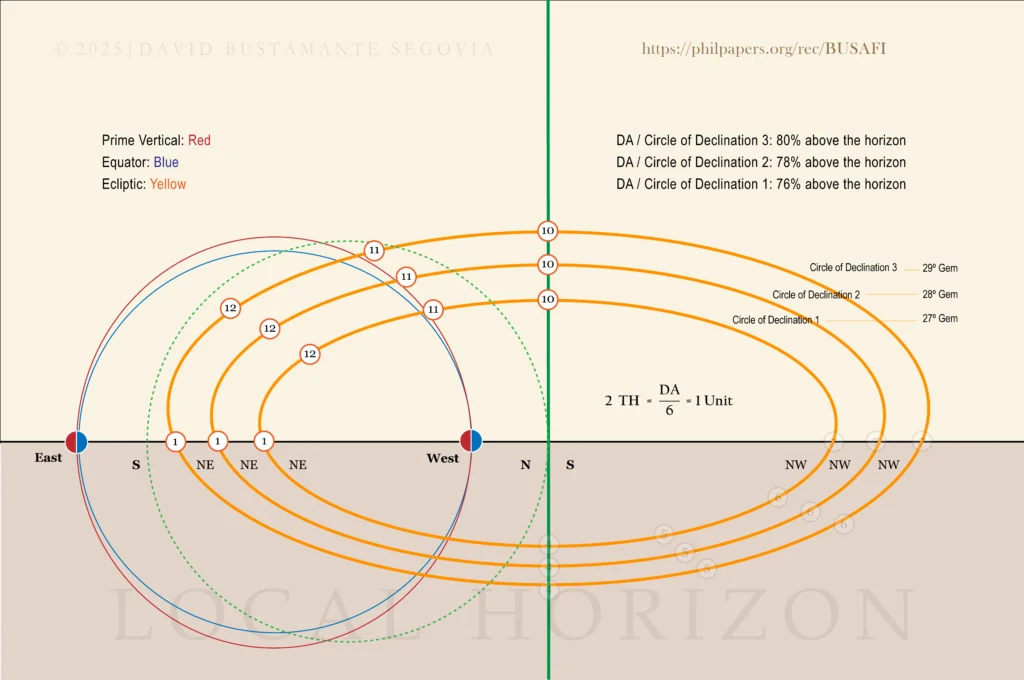
Requesting statistics for a geometrically unfeasible system of celestial partitioning (e.g. Campano’s first vertical; Regiomontanus’ celestial equator; Alcabitius’s or Koch’s single circle of declination; Polich’s tangents or straight lines) is like requesting consistent evidence that a vehicle with a faulty engine can still win a race or wishing to determine which of all vehicles with a faulty engine can do so.


Consider understanding it as follows: if the measuring tape (i.e., domification) is elastic, the data it yields will be corrupted at the source. Our research focuses upon the blueprints. If it is proven that the geometry of the standard grid constitutes a two-dimensional fiction imposed upon a three-dimensional reality, no volume of data can rescue its validity. A celestial object is either where the coordinate method says it is, or it is not. Astrology may be about or inquire into human experience, but one cannot interpret a human event exploiting a coordinate upon which the object or planet was never located (statistical ghosts). To do so is to invoke statistical ghosts: attributing a symbol to a physically non-existent position.
If spherical geometry is correct, the truth has been established and the validity of the method is absolute irrespective of whether it coincides with the Saturday of the celebrity’s death. Astronomy and physics need not biographical permission to be ratified. Interpretation is a human exercise, not a natural one.
Internal geometric necessity
If any system (Placidus, Regiomontanus, Campanus, Polich, sign-houses, etc.) can be made to “work” through retroactive fitting (abuse of statistical regression), then no system is being held accountable to the truth. Our priority is, therefore, a priori truth: a geometry that is true independent of the observer’s biography.
The necessity of scrutiny
The role of our research is metrological, scientific, and forensic. We scrutinise the methodology of different coordinate transformation methods, define units, describe the trajectory of arcs, and explain the results. While we consider celestial inference (interpretation) to be a valid practise, we consider the premise upon which the overwhelming majority of statistical “analyses” are based to be flawed and the application of inductive reasoning to be abusive [1]. It is from this “rigged casino” of the discipline that broken mechanics and reasoning are justified in light of retroactively selected coincidences, from which we remain aloof. In the case of broken mechanics, it is necessary to calibrate the rule before trusting the measurement.
Conclusion
Should we allow the biography to dictate the validity of the coordinate system, we have entered into the «rigged casino» of interpretation. In such environment, isolating a single dominant variable constitutes a methodological impossibility. To claim that a system of houses or celestial partitioning is “accurate” because a symbol (necessarily broad) matched a life event (whose window is also intrinsically broad) is not science; it is a failure to account for statistical noise, the laws of probability, and the nature of the human experience (as understood by medicine, genetics, and developmental psychology).
______________________________
[1] The latter attempts to derive universal laws from the super-isolated observation of variables: the claim that a planet in sector X constitutes a sufficient cause, rather than merely a necessary one, to produce effect Y, ignoring that celestial inference is systemic and that the same astrographic location operates under biological and contextual conditions that are unique to each subject, just as the same disease does in different patients. Saturn in House 9 is not a “verdict”; it is a component whose expression depends on the network of relationships (aspects, regencies, dignities) with the rest of the system. Isolating it for statistical purposes is like trying to understand how the heart works without looking at the rest of the circulatory system. A configuration may be necessary for an event to occur, but it is not sufficient on its own. The statistics of some authors or journals fail by assuming that the presence of factor A must always lead to result B, ignoring the joint or combined action of the whole.



Excellent article. I love this sentence: “In science, this is known as “p-hacking” or “data dredging”: torturing the data until it confesses what one wants to hear, that is, until a statistically significant result appears.”. This is a brilliant way to state what astrologers usually do.