Physical Address
The Woodlands, TX, USA
Physical Address
The Woodlands, TX, USA

During the editorial review of a forthcoming publication on the subject, it became an intellectual necessity to provide a description exclusively dedicated to «arrival times» and the reasons why they must remain a priority for both students and professionals. Often, what is self-evident to the researcher remains obscured for the casual observer. This article, though brief, seeks to bridge that gap. By clarifying this fundamental concept in isolation, we ensure that the terminology in future works is met not with unfamiliarity, but with rigorous comprehension. For a comprehensive quantitative analysis of arrival times and the diurnal motion responsible for them, I refer the reader to: Astronomical Fidelity in Historical Coordinate Systems of Celestial Partitioning: Quantitative Comparison of Linear vs. non-Linear Measurements.
Definition
A (house) cusp refers to the zodiacal degree (i.e., point of the ecliptic) that, at a certain time, occupies a certain position in the sky relative to the plane of the local horizon. In this sense, it is a function of ecliptic coordinate and, by extension, of its specific declination. (Declinations determines the physical behaviour of the point.) After all, a point upon the ecliptic or zodiacal degree constitutes a solar footprint [1], that is, all ecliptic points or zodiacal degrees behave as the sun would have behaved when it occupied that point or degree (coordinate) upon that local horizon. It inherits the Sun’s specific declination and, consequently, its precise duration above or below the local horizon.
Consequence or relevance
A cusp, therefore, is the same as an ASC with regard to another segment of the horizon (i.e., celestial partition unit). In the same way that we are interested in determining the exact time at which a given zodiacal point reaches the surface of the local horizon in order to designate that degree ‘ASC’ (i.e., cusp of the first house of the celestial map), determining the exact time when another zodiacal point (with a different declination, necessarily) reaches another region of the local horizon is equally necessary, and is known as ‘the cusp of’ [whichever house is in question]. Or, should you prefer, successive Ascendants (ASCs).[2]
The problem
Calculating the rest of the ‘times of arrival’ without a visible frame of reference (such as the surface of the horizon) or a geometric frame of reference (such as the local meridian) was extremely difficult before the advent of logarithms.
The necessity for a solution
However, just as the community agrees that we must not miss the ‘time of arrival’ of the zodiacal degree that constitutes the ASC, neither must we miss the ‘time of arrival’ of the rest of the zodiacal degrees to the rest of the regions of the local horizon. Determining the exact time at which another zodiacal point reaches another region of the horizon is equally necessary; ignoring this precision is not a methodological option, but a renunciation of observational truth.
Conceptual clarity
The question then arises as to whether the calculation of the remaining arrival times is as verifiable and unambiguous as that of an ASC or an MC. The answer is a categorical yes. The reason is fundamental: defining the true apparent trajectory of any zodiacal point upon a specific horizon is equivalent to defining the true apparent trajectory of the sun upon that same horizon, irrespective of which celestial body (the sun or another) occupies that coordinate on a given date. The temporal structure of the sky—its mechanics of ascension and culmination—remains a constant and verifiable unalterable physical reality.[3]
Flat math?
The utilization of reference frames foreign to the ecliptic [4]—the plane upon which, by physical necessity, the cusps lie—such as the celestial equator (Regiomontanus) or the prime vertical (Campanus of Novara), served historically to facilitate manual computation. However, these projections yield only approximate results, with their inherent distortion increasing in direct proportion to the obliquity of the local horizon and geographical latitude.[5]
These models functioned as “geometric shortcuts” and are categorised today as linear or flat math. Their fundamental flaw lies in disregarding the sinuous, serpentine wobble of the ecliptic. By treating the mundane sphere as a static grid rather than a dynamic, temporal phenomenon, these methods fail to account for the true apparent trajectory of zodiacal points: the diurnal arc.[6]
The ineluctable necessity for proportional measurement
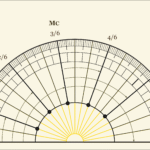
Because this apparent trajectory (diurnal arc) constitutes a direct function of its specific declination, its calculation cannot be linear; it must be strictly proportional to the temporal length of the diurnal arc of the zodiacal degree in question. Whether we consider the tenth (MC), the first (ASC), or the ninth cusp, each specific point remains subject to a division into six equal temporal parts. Consequently, Placidian or Ptolemaic houses present variable temporal lengths or durations (2009, Michelsen, pp. 30-31), as they are the product of six separate or independent temporal trisections. [7] Just as every MC and ASC invariably constitutes exactly three-sixths (3/6) and six-sixths (6/6), respectively, of their specific diurnal arcs, every ninth cusp, for example, must constitute exactly four-sixths (4/6) of the diurnal arc of that particular cuspal degree.[8]
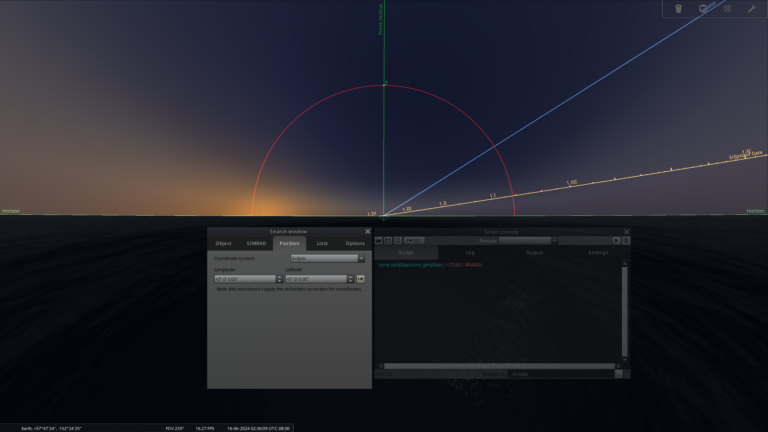
While the animation below clarifies the above visually, you will find more literature on the same phenomenon, amongst others, here.
Conclusion
We employed linear methods not because they were ‘right,’ but because they were ‘easy.’ Now that we have the computing power, continuing to employe the ‘easy’ cumulative temporal error is an ethical failure.
____________________________
[1] The metaphor of the ‘solar footprint’ allows any reader, even without a mathematical background, to understand that the sky is not a static drawing but a record of light and time.
[2] By acknowledging every subsequent cusp as the phenomenological equivalent of an Ascendant—as if the horizon had displaced itself, which is what actually occurs uninterruptedly as the Earth rotates—we dissolve the arbitrary hierarchies imposed by human artifice and restore the sky to its sovereign mechanical integrity: primary motion. To grasp the architecture of the mundane sphere, one must perceive each cusp as a ‘sub-ASC’, that is, as a distinct station of a singular natural truth, for even though we may assign the Ascendant (ASC) and the Midheaven (MC) a superior relevance compared to the rest of the cusps, the mechanism of action responsible remains the same: all cusps are produced by the same single phenomenon: primary motion. It is for this reason that arrival times are both fundamental and non-negotiable. Philosophical orientation or methodological preference bears no relevance to the matter at hand. They do, however, bear relevance in the interpretation of the actual sky. Celestial partitioning, as opposed to interpretation, constitutes a problem in engineering, not philosophy.
[3] Introducing the idea that the trajectory constitutes an ‘unalterable physical reality’ means that the astrologer does not ‘invent‘ the house, but rather ‘measures’ a structure that already exists in local space-time.
[4] By employing the word foreign, we qualify Regiomontanus’ celestial equator and Campano’s first vertical as intruders into the natural or organic domain of the cusps.
[5] The reference frames of the ‘tradition’ were not a choice of wisdom but a concession to technical limitations (manual calculation).
[6] With this, we remove or refute the aura of ‘historical authority’ of these frames of reference or systems of house division in order to present them as what they truly were: tools of convenience for an era without computing.
[7] Placidus is the sole method that respects the physics of time. By clarifying that they constitute ‘independent temporal trisections,’ we have explained the reason for which the houses (i.e., volumes that contract and expand according to seasonal time) present different sizes/durations (unlike those of Regiomontanus or Campanus, Alcabitius or Koch, whose symmetry is fictitious) without a need for complex formulas.
[8] On this occasion, we remove or refute the aura of ‘complexity’ and present it according to its true essence: pure natural proportion.