Physical Address
The Woodlands, TX, USA
Physical Address
The Woodlands, TX, USA

It is often erroneously claimed that the Regiomontanus (RGM) method of celestial partitioning uniquely represents the physical position of a celestial body on the local horizon, primarily because the method relies upon a formal spatial division of the celestial equator. Proponents frequently argue that this specific geometric foundation, therefore, makes RGM the superior coordinate system for locating lost objects within horary astrology.
This assertion, however, fails under the rigour of spherical geometry. When tasked with explaining how an equatorial partitioning can accurately project the physical position of a body that lies upon the ecliptic—not the equator—the argument collapses. The persistence of this “myth” highlights a surprising lack of basic geometric literacy among even well-regarded authors in the field, including those with formal backgrounds in mathematics, geometry, or physics who overlook the fundamental mechanics of the «local» horizon, where each zodiacal point constitutes a function of its specific «zodiacal declination». While it is true that the celestial equator represents the plane of the Earth’s rotational axis, the division of the horizon into houses (celestial partitioning) constitutes an exercise in topocentric, not universal, measurement.
The equipartite partitioning of the celestial equator represents a mathematical abstraction that fails to account for the specific declination of points throughout the ecliptic. Because a celestial body’s position on the local horizon constitutes a function of both geographic latitude and its specific zodiacal/ecliptic declination, an equatorial model remains insufficient for determining true topocentric coordinates (see the 11 November 2025 paper “Astronomical Fidelity”). In this sense, even if we were to project the relevant points of the celestial equator onto the ecliptic (through great circles spanning from south to north or north to south), these would not correspond or be linearly proportional to the amount of time required for that point of the ecliptic to occupy or take that position upon the local horizon.
In applications such as horary astrology—where the location of a lost object is of interest—the observer requires a projection of the body’s actual physical position (i.e, altitude and azimuth), rather than an idealized partition that assumes that the sky behaves like a clock with uniform gears, that is, that presupposes a uniform mechanical celestial behaviour. Frequently, practitioners with technical backgrounds in external fields apply geometry in a static manner, overlooking the fact that house systems are dynamic phenomena intrinsically dependent on the observer’s specific latitudinal perspective.
Forensic Geometry
If we were to rely solely upon the poles of the celestial equator to discern the ASC, we would never find it (i.e., except during the vernal and autumnal equinoxes). This discrepancy arises because the celestial equator, like the prime vertical, remains fixed at the cardinal east and west points of the horizon. In contrast, the ecliptic—the plane upon which all house cusps lie, including the ASC—deviates from these specific horizontal points due to its obliquity, a divergence that reaches its maximum during the summer and winter solstices.
Furthermore, the utilization of the prime vertical—as proposed by Campanus of Novara in the thirteenth century—proves insufficient for the accurate determination of intermediate cusps. This is due to a fundamental lack of proportionality: just as 30º of right ascension (RA) along the celestial equator does not correspond linearly to the temporal interval or amount of time required for ecliptic points to reach the corresponding cuspal thresholds, a 30º increment of altitude (alt.) along the prime vertical fails to account for the non-linear motion of the ecliptic. Should we need to judge the purchasing power between two currencies in the world (e.g., the dollar or USD and the yuan or CNY), proportionality would be the principle without which an accurate judgement would not be possible.
Given that the majority of ecliptic points do not coincide with the celestial equator or the prime vertical, the 30º increments within these reference frames were not intended as the final planes of measurement by Regiomontanus or Campanus. Rather, during the thirteenth and fifteenth centuries, these served merely as auxiliary great circles used to project the circles of position that intersected the ecliptic upon relatively approximate points (due to times of arrival not being exact). These methodologies provided only approximations necessitated by the lack of latitude-specific planispheric astrolabes and the absence of logarithms, the latter of which would not emerge until the seventeenth century (AFA, 2014, p. vii; Napier, 1614).
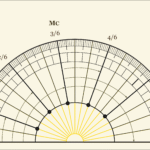
The consistent accuracy of the great circle intersecting the Medium Coeli (MC) across all horizons—specifically its invariable alignment with the three-sixth midpoint of the diurnal arc—is a direct consequence of the Earth’s axial orientation. Because the meridian plane is co-planar with the Earth’s axis of rotation, the MC and IC can be identified through strictly spatial or Euclidean geometry. Succinctly expounded: the MC and IC maintain a fixed alignment with the north-south azimuthal axis, a geometric stability that the Ascendant (ASC) and Descendant (DES) do not share.
For a more detailed explanation of forensic geometry, see Why Cannot the Celestial Equator Find the Ascendant?