Physical Address
The Woodlands, TX, USA
Physical Address
The Woodlands, TX, USA

American theoretical physicist Richard P. Feynman (1918–1988) firmly believed that if you couldn’t visualise it, you didn’t understand it. Visualising a concept, in astronomical terms, is nothing more than drawing it in our own minds in three dimensions. Our work to illustrate the mathematical identity of a cusp, angular or otherwise, transforms an exceptionally difficult concept to elucidate (hour lines or cusps, or time of arrival) into a clear visual experience.
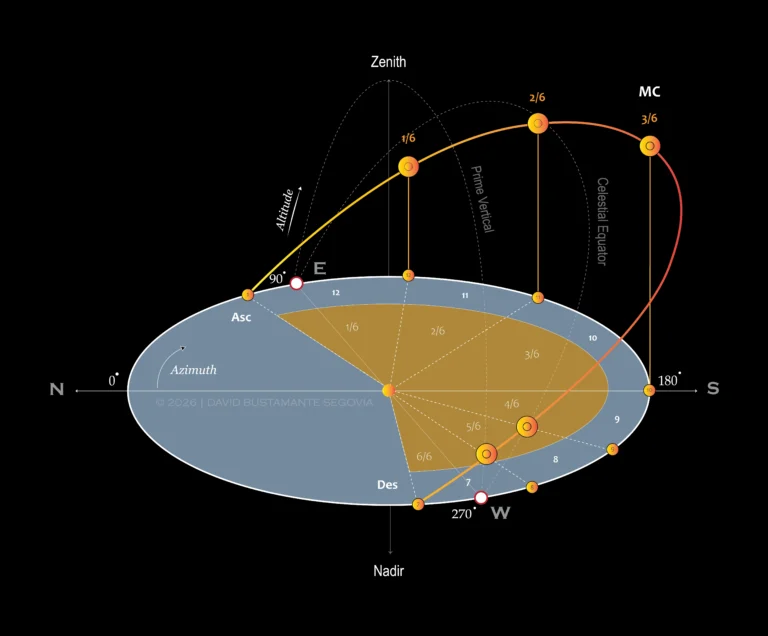
Figure 1. Anatomy of an Organic Horizon
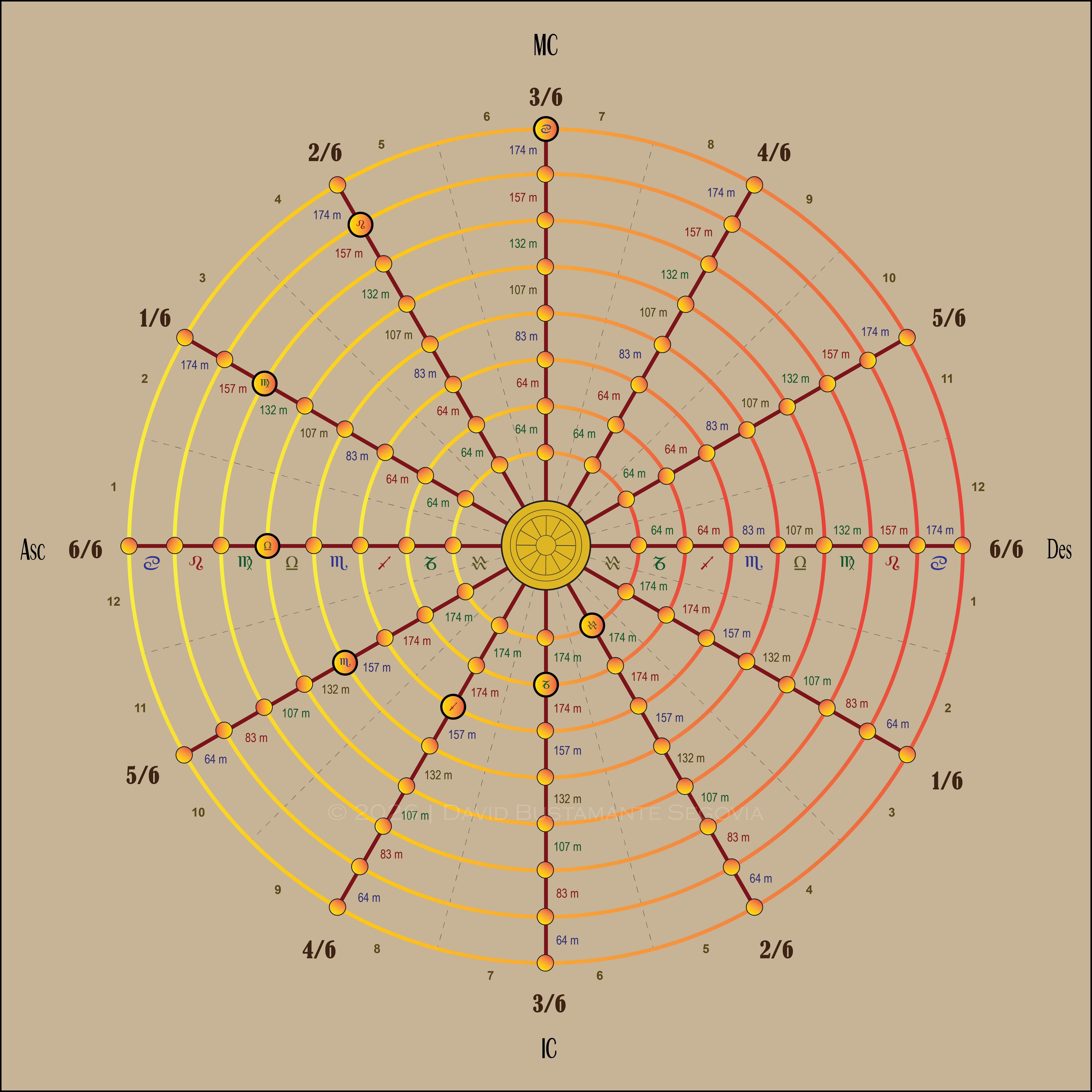
Legend
Conceptual Explanation
A. The principle of the angles: An Ascendant (the zodiacal degree constituting the cusp of the first house) constitutes the exact point of intersection between the ecliptic and the local eastern horizon, marking the absolute genesis of its diurnal arc (and the conclusion of its nocturnal arc). In turn, the Midheaven or MC (the zodiacal degree constituting the cusp of the tenth house) is the point of intersection between the ecliptic and the local meridian, where said degree completes exactly half of its diurnal arc, achieving culmination. In this sense, every Ascendant and Midheaven functions as a direct mathematical derivative of terrestrial rotation and the specific declination of that ecliptic coordinate at a given latitude (e.g., an Ascendant will vary at the exact same absolute moment across different latitudes sharing the identical meridian). Whether these angular coordinates are projected under Placidian, Regiomontanian, Campanian, or Porphyrian frameworks—be it in Kodiak, London, or the Caribbean—the physical reality remains invariant: these degrees fluctuate strictly according to the specific apparent angular motion dictated by the observer’s latitude.
B. The Proportional Amplitude of Houses:. As one moves across the various concentric parallels of declination (see Fig. 1), the absolute spatial distance metric varies (expanding or contracting); however, the temporal proportion (one-sixth, 1/6) remains mathematically absolute. This kinematic principle constitutes the operational core of the authentic Ptolemaic-Placidian method (Worsdale, 1828; Gansten, 2009). Because each degree of the ecliptic intersects the horizon at a distinct topocentric coordinate (azimuth and altitude) strictly dictated by its declination, the absolute duration of its diurnal arc fluctuates continuously. Consequently, the absolute magnitude—in clock minutes—of that 1/6 temporal fraction also varies (e.g., 174 m vs. 64 m), thereby defining the amplitude of a natural house. By physical definition, the geometric extent of a natural house equates exactly to one-sixth of the diurnal or nocturnal arc of its presiding cuspal degree.
C. The Criterion of Falsifiability: By segmenting each individual diurnal arc into temporally proportional intervals (two seasonal hours, equivalent to 1/6 of the total arc), intermediate cusps are derived from the exact same kinetic principle that governs the angular cusps (diurnal motion). This preserves the mathematical identity of a cusp across the entire celestial vault and establishes a strict criterion of geometric falsifiability. For example: if a system projects a specific ecliptic degree as the cusp of the twelfth house, but a celestial body occupying that degree requires an absolute time metrically distinct from 1/6 of its diurnal arc to travel from the eastern horizon to that spatial coordinate, the system lacks topocentric fidelity. It has forcibly imposed an arbitrary spatial position upon an empirical temporal trajectory. Given that each ecliptic degree possesses a unique and verifiable rate of oblique ascension, any posited cusp that deviates from this rate of kinetic maturation (time of arrival) constitutes a geometric anomaly, not a physical reality.
D. The Constant of Celestial Partition: Through the proportional division of individual arcs, the fundamental unit of celestial partitioning (the astrological house) is inexorably defined by the constant of two seasonal (oblique) hours. This formulation guarantees an absolute kinetic equivalence across the ecliptic-horizon relationship, maintaining a perfect proportional symmetry that transcends and resolves the inevitable spatial distortions dictated by axial obliquity.