Physical Address
The Woodlands, TX, USA
Physical Address
The Woodlands, TX, USA
The term isophasal derives from the Greek isos (equal) and phasis (phase). In the context of celestial mechanics and the Placidian (Placidus of Titis) method of coordinate transformation, an isophasal curve is the line drawn in the three-dimensional sphere connecting all points that have completed an identical proportion of their respective ascensional time (e.g., two oblique or seasonal hours of their diurnal/nocturnal duration). Irrespective of the absolute metric length of their respective paths across the observer’s local horizon, this curve demarcates the simultaneous completion of a specific kinetic proportion (e.g., 1/6, 1/3, or 1/2 of the diurnal arc). To visualise this phenomenon with geometric and physical rigour, let us examine the behaviour of two distinct celestial objects or ecliptic markers with divergent declinations—the Equinox (00º Aries) and the Summer Solstice (00º Cancer)—within the local sky:
1. The physical premise (unequal arcs)
2. The construction of the isophasal curve (cusps)
When determining the cusp of the twelfth house within this conceptual framework, it is established that this sector commences at the precise moment a zodiacal degree completes one-third (1/3) of its diurnal semiarc—equivalent to one-sixth (1/6) of its total diurnal arc.
This mathematical operation is iterated continuously across an infinite continuum of ecliptic points and declinations, or, in the case of horoscope construction (topocentricity), six times. To complete the domification of the visible sphere, the calculation identifies which zodiacal degrees have fulfilled successive temporal proportions: 2/6, 3/6, 4/6, 5/6, and 6/6 of their respective arcs. It is mathematically axiomatic that the local meridian (Midheaven) and the western horizon (Descendant) inevitably represent the 3/6 and 6/6 proportions of the diurnal arcs of the culminating and setting degrees, respectively, just as the Ascendant represents the foundational proportion (0/6, the genesis of the visible/diurnal arc, or 6/6, the completion of the invisible/nocturnal arc).
The continuous line or locus connecting these points of proportional kinetic maturation in three-dimensional space constitutes the isophasal curve of Ptolemy (100–170 AD)[1] and Placidus (1603-1668).[2]
3. Why is it a “complex curve” and not a great circle?
It is within this precise geometric analysis that Polich’s primary refutation (his “straw man”) collapses (1976, Ch. 1, p. 2, para. ‘a’). Coordinate transformation methods such as those of Campanus (1220-1296) or Regiomontanus (1436-1476) do partition space by sectioning the sphere employing great circles (perfectly planar and symmetrical vectors, analogous to longitudinal meridians). Placidus, however, does not divide the Euclidean space falsely assuming that the horizon is independent from the obliquity of the ecliptic (sole generative source of the cusps, as these do not lie upon the equator). Instead, it directly measures oblique time.
Given that the isophasal weaves or integrates spatial coordinates whose temporal matrices possess divergent absolute durations (e.g., two hours versus three hours), the resulting line structuring the cusps across the celestial vault cannot, by geometric definition, constitute a straight, planar, or symmetrical circle. The line is mathematically compelled to curve across the various parallels of declination to preserve the constancy of the proportion. It is a complex, three-dimensional curve generated exclusively by the kinetics of the Earth’s rotation (primary motion) as experienced at a specific latitude, responding organically to the periods of light intensity (refer to our Periodic Index of Light Intensity, or IPIL).
When Polich asserts that his system invalidated its predecessors because “they were all based on great circles,” he commits a severe fallacy of false geometric equivalence. The cuspal markers of a diurnal arc (zodiacal degree) in the Placidian framework were never a product of static great circles, but of a kinetic wave—an isophasal curve comprised of ecliptic coordinates that, despite traveling at varying apparent angular velocities and covering divergent metric distances, share the exact same state of temporal maturation (e.g., 1/3 or 2/3 of their respective semi-arcs) in a certain latitude.[3]
While Placidus projected time onto space, Polich attempted to partition space utilising straight tangent lines to simulate or imitate the curved nature of oblique time. This methodological discrepancy explains the geometric fracture of the purportedly topocentric system at high latitudes: a linear tangent cannot parallel an isophasal curve indefinitely. Whilst the tangent and the curve travel with negligible deviation at equatorial latitudes, they progressively diverge beyond 23.5° N/S. The mathematical flaw inherent in Polich’s methodology at all latitudes becomes simply untenable and obvious to the naked eye from a certain latitude onwards, whilst the isophasal curve remains unaffected by obliquity across the entire globe.
4. Analysis of an empirical illustration
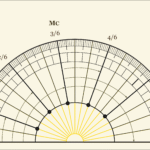

The accompanying diagram visually and mathematically deconstructs the Ptolemaic-Placidian model:
4.1. The diurnal arcs (concentric parallels)
The concentric circles constitute the distinct parallels of declination and the diurnal or nocturnal arcs traced by the corresponding zodiacal degree. Therefore, they describe the physical path traversed by each one. Because each concentric parallel possesses a unique total temporal duration above or below the horizon, the absolute magnitude of a one-sixth (1/6) proportion varies intrinsically with declination (e.g., 174 minutes, 107 minutes, etc.). Ptolemy and Placidus operate upon the kinematic axiom that each zodiacal degree transverses its own independent longitudinal trajectory or ‘track.’
4.2. Strict temporal trisection (radial axes 1/6, 2/6, 3/6)
The radial vectors dividing the diagram signify pure temporal fractions. For instance, the first third (1/3) of the diurnal semi-arc intersects the axis denoting the 1/6 fraction of the total arc. If the Earth lacked axial obliquity and diurnal motion were linearly uniform, the intermediate cusps (e.g., the 12th, 11th, and 10th houses) would perfectly map onto these straight radial vectors. However, terrestrial sphericity and axial inclination render such flat Euclidean projections geometrically invalid. The nature of the phenomenon does not allow for such a methodology.
4.3. The isophasal locus (intersection curves)
The diagram geometrically demonstrates why Ptolemaic-Placidian mechanics precludes the deployment of straight vectors or great circles. It illustrates how an identical state of temporal maturation—specifically, one-sixth (1/6) of the diurnal arc—materialises at divergent geocentric coordinates (ecliptic longitudes) depending entirely upon the degree of declination:
By connecting these specific spatial coordinates—which share an identical state of kinetic maturation (1/6) across all declination parallels—the Placidian isophasal curve (house cusps) is unequivocally generated. This oscillating, non-linear locus traversing the local sphere constitutes the singular geometric mechanism capable of deducing the intermediate cusps via the exact kinematic principle that defines the angular cusps: diurnal motion. Consequently, intermediate cusps are not static spatial abstractions; they are mathematically functional ‘sub-Ascendants.’ As the Asc and the MC, they are natural cusps.
5. The Empirical Refutation of the Topocentric Model
This graphical representation empirically dismantles the foundational premise of the Polich-Page methodology, exposing the severe mathematical limitations of a tangent-based construct:
5.1. The geometric impossibility of the great circle
Placidus does not project great circles due to a natural absolute mathematical constraint: to connect spatial coordinates representing unequal absolute durations but identical proportional (seasonal) times, the resulting locus must inherently curve across the parallels of declination. The diagram visually proves that authentic cusps cannot be straight radial vectors, thereby exposing both the geometric invalidity of exclusively spatial methods (which ignore obliquity) and the historical falsity of Polich’s critique of Placidian mechanics.
5.2. The fracture of the linear instrument
Polich attempted to replicate this complex isophasal curve by imposing a rigid Euclidean tool—the straight tangent. As illustrated, as declination increases toward the extrema (the innermost or outermost concentric parallels), the natural kinematic curve deviates drastically from any linear projection. Polich’s tangential ‘rigid ruler’ forcibly detaches from observable physics, inducing critical temporal discrepancies in cuspal arrival times. Although this mechanical error is inherently built into the methodology for any location on the globe, the linear fracture would become empirically untenable at latitudes of 45° N/S.
The illustration serves as expert geometric evidence that the Topocentric System conflated a trigonometric approximation with kinematic reality. Whilst Polich deployed a tangent that projects outside the actual physical trajectory, the Placidian methodology measures time directly upon the curve itself. This non-linear approach insulates the system from the distortions of obliquity by utilising the obliquity itself as the foundational unit of measurement.
6. Conclusion
If one accepts the irrefutable astronomical axiom that the ascending degree (Ascendant) varies at the exact same moment across varying latitudes sharing the same meridian (e.g., Accra, Valencia, and London), it logically dictates that the oblique or seasonal hour constitutes the singular natural and universal metric for partitioning local space. It is, therefore, the exclusive, mathematically exact source of positional truth in celestial domification.
Figure 1. Geometric and Kinematic Elements of the Placidian Isophasal Curve
Legend
Concentric parallels (orange tracks): The diurnal arcs corresponding to distinct parallels of declination. These represent the specific physical trajectories traversed by individual ecliptic degrees. The outermost parallel denotes the maximum northern declination (Cancer), whereas the innermost parallel denotes the maximum southern declination (Capricorn).
Red radial vectors (straight axes): The linear demarcations indicating pure temporal fractions (1/6, 2/6, 3/6, etc.) of the diurnal arc, projecting spatial symmetry with respect to the local horizon.
Zodiacal glyphs: The specific ecliptic coordinates traversing their independent longitudinal tracks across the local sphere.
Absolute time values (e.g., 174 m, 107 m, 64 m): The absolute metric duration (clock time, in minutes) required for a specific ecliptic coordinate to complete exactly one-sixth (1/6) of its unique diurnal arc at the observer’s latitude. The sum of all sixths is equal to the total length of the arc.
Intersecting nodes (orange dots): The exact spatial coordinates where an ecliptic degree mathematically fulfills the requisite kinetic proportion (e.g., 1/6 or 2/6 of its diurnal arc).
Kinetic proportions (1/6 through 6/6): The fractional states of diurnal maturation (equivalent to oblique or seasonal hours). The 3/6 proportion mathematically dictates culmination at the local meridian (MC), whereas the 6/6 proportion dictates the setting of the coordinate at the western horizon (Des).
The continuous white locus (isophasal curve): The authentic Placidian cusps. A non-linear, kinematic wave structurally connecting all spatial nodes that share an identical state of proportional temporal maturation across divergent declinations.
________________________
[1] Tetrabiblos (1940), III, 10, 286-289. Loeb. See also fn. 3 of the translator.
[2] Primum Mobile (1814), pp. 5-7.
[3] A cusp is the result of the synthesis of latitude, declination, and rotation/primary motion.
[4] It must be noted that a seasonal or oblique hour does not correspond to a fixed duration of 60 standard minutes. Consequently, two seasonal hours will contain either more or fewer absolute minutes depending entirely upon the diurnal duration of the specific coordinate at the observer’s latitude.
[5] Such a coordinate would rise in closer proximity to the exact eastern point, as opposed to rising several degrees north of the eastern point—a phenomenon characteristic of extreme northern declinations at mid-to-high latitudes in the northern hemisphere (and vice versa for the southern hemisphere).