Physical Address
The Woodlands, TX, USA
Physical Address
The Woodlands, TX, USA

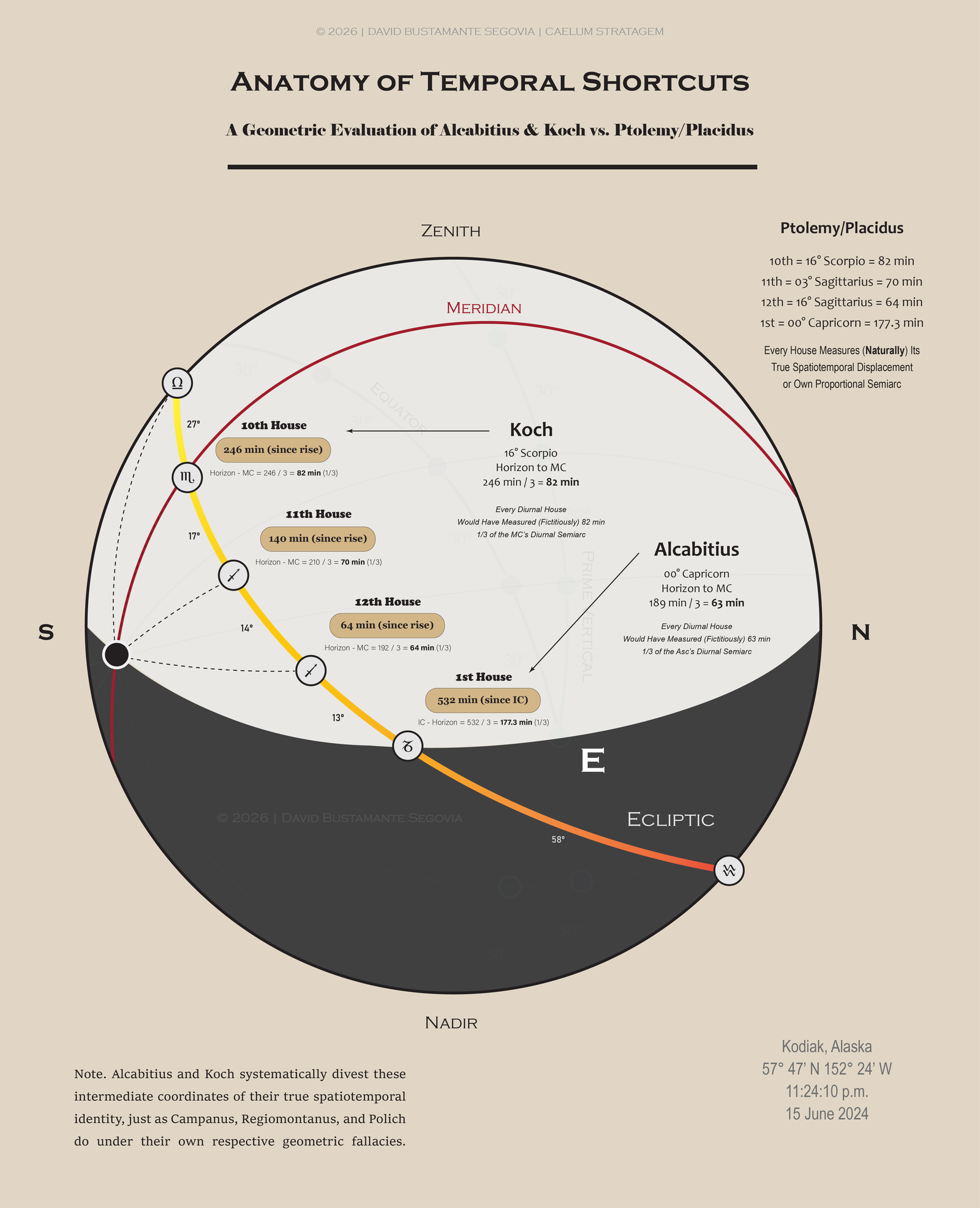
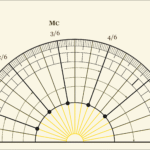
In 1971, the Koch method of celestial partitioning, developed by Walter Koch (1895–1970), was introduced to the astrological community under the same pretext as that of Wendel Polich: “the birthplace method” (Koch, 1971). Because it was cloaked in twentieth-century authority, only a few practitioners (e.g., Ralph W. Holden, Neil F. Michelsen) realised they were simply being handed a tenth-century mathematical shortcut—and geometric error—in reverse (Holden, 1977/2023, pp. 126–129; Michelsen, 1997/2009, p. 23; Bustamante, 2026, Correlation 38:2)
Structurally, the Koch system constitutes a contemporary mirror of the medieval method of Alcabitius (Abū al-Ṣaqr ʿAbd al-ʿAzīz ibn ʿUthmān al-Qabīṣī, d. 967 CE)—a pre-logarithmic computational shortcut designed to avoid solving the complex trigonometric fractions demanded by synchronic diurnal motion (the simultaneous displacement of all tropical zodiacal degrees at the moment of birth), as postulated by Ptolemy and mathematically achieved by Magini and Placidus in the seventeenth century.
Whereas Alcabitius uniformly projected the Ascendant’s (Asc) ascensional time across the entire quadrant, twentieth-century practitioners simply rotated that exact same geometric error to the Midheaven (MC):
Consequently, neither system measures the true kinematic displacement of the intermediate coordinates: their actual position relative to the local horizon, dictated by their own oblique ascension or declination, just as it is for every Ascendant and Midheaven.
Two distinct coordinates with unique declinations are lodged within the intermediate space. One is completing exactly one-third (1/3) of its own diurnal semi-arc (12th House = 16° Sagittarius), whilst the other completes two-thirds (2/3) of its own diurnal semi-arc (11th House = 03° Sagittarius). The Midheaven, in turn, completes its full diurnal semi-arc (3/3, or 50% of its diurnal arc), in the exact same kinematic manner that the Ascendant completes its nocturnal semi-arc (3/3, or 100% of its nocturnal arc) to initiate its diurnal trajectory (0/3 or 0%).
Irrespective of the method of partitioning, all Ascendants and Midheavens are inherently derived by proportional times. The MC always represents 50% of its own diurnal arc, whereas the Asc represents 100% of its own nocturnal arc, or second half (50%).
An unprecedented taxonomy of celestial partitioning
To truly understand the anatomy of error, the practitioner must first master the mechanism of celestial partitioning. Following the release of our master manual for cuspal verification (September 30, 2026), Caelum Stratagem will publish A Formal Taxonomy of Celestial Partitioning on Thursday, October 15, 2026—an objective, encyclopedic index that evaluates every major historical framework (Ptolemy, Regiomontanus, Campanus, Alcabitius, Koch, and Polich) against the inexorable laws of apparent diurnal motion.
The ancients understood an epistemological baseline that the contemporary practice has largely forgotten: mensuration precedes interpretation. Before a celestial coordinate can ever signify anything, it must first physically exist somewhere at a specific diurnal/nocturnal time (hour, minute, second) and in a specific space (azimuth, altitude) of the observer’s latitude.