Physical Address
The Woodlands, TX, USA
Physical Address
The Woodlands, TX, USA


One Cannot Divide What One Cannot Measure
Every Ascendant and Midheaven is, intrinsically, a coordinate derived by the corresponding proportion of its own oblique ascension; its emergence over the horizon or culmination upon the meridian serves exclusively as the visual proof that the spatiotemporal fraction of its semi-arc has consummated.
Because intermediate cusps lack observational markers, determining their position is impossible without calculating the precise spatiotemporal fraction of their respective semi-arcs. In truth, no ecliptic degree can rise, culminate, set, or reach a specific altitude and azimuth without first completing the exact proportional fraction of its own diurnal arc.
The Conflation of Time and Space
It is precisely at this juncture that the historical divergence in celestial partitioning originates. The root of this mathematical discrepancy did not emerge from flawed calculus, but rather from a fundamental conceptual error: the conflation of time with space.
Practitioners and theoreticians alike observed the clean, static spatial planes of the horizon and the meridian, erroneously assuming the Ascendant and Midheaven to be inherent spatial constructs. Failing to recognize that these primary axes function fundamentally as temporal milestones that merely coincide with physical planes, they postulated that the intermediate cusps (the eleventh, twelfth, second, and third houses) must be ascertained using identical spatial logic—a methodology entirely alien to their true kinematic nature.
In their attempt to assign universal, static visual markers to intermediate cusps, subsequent authors introduced systematic geometric fallacies, substituting true time-proportional motion with the exogenous projection of foreign spatial grids:
The Exogenous Altitudinal Error (Campanus)
The Campanus methodology discards the non-linear kinematics of oblique ascension, opting instead to divide the prime vertical into equal segments of exactly 30 degrees of altitude. It subsequently constructs artificial circles of position, passing them through these uniform altitudinal marks to synthetically intersect the ecliptic. The structural error lies in the assumption that an equipartite spatial segmentation of an exogenous reference frame can serve as a valid proxy for oblique time.
The Exogenous Equatorial Error (Regiomontanus)
A parallel systemic failure occurs when the framework retreats to the celestial equator, dividing it into equal segments of exactly 30 degrees of right ascension. Because the ecliptic ascends obliquely, projecting these uniform equatorial segments onto the ecliptic structurally decouples the measurement from true kinematic displacement.
Non-Linearity and the Ecliptic Locus
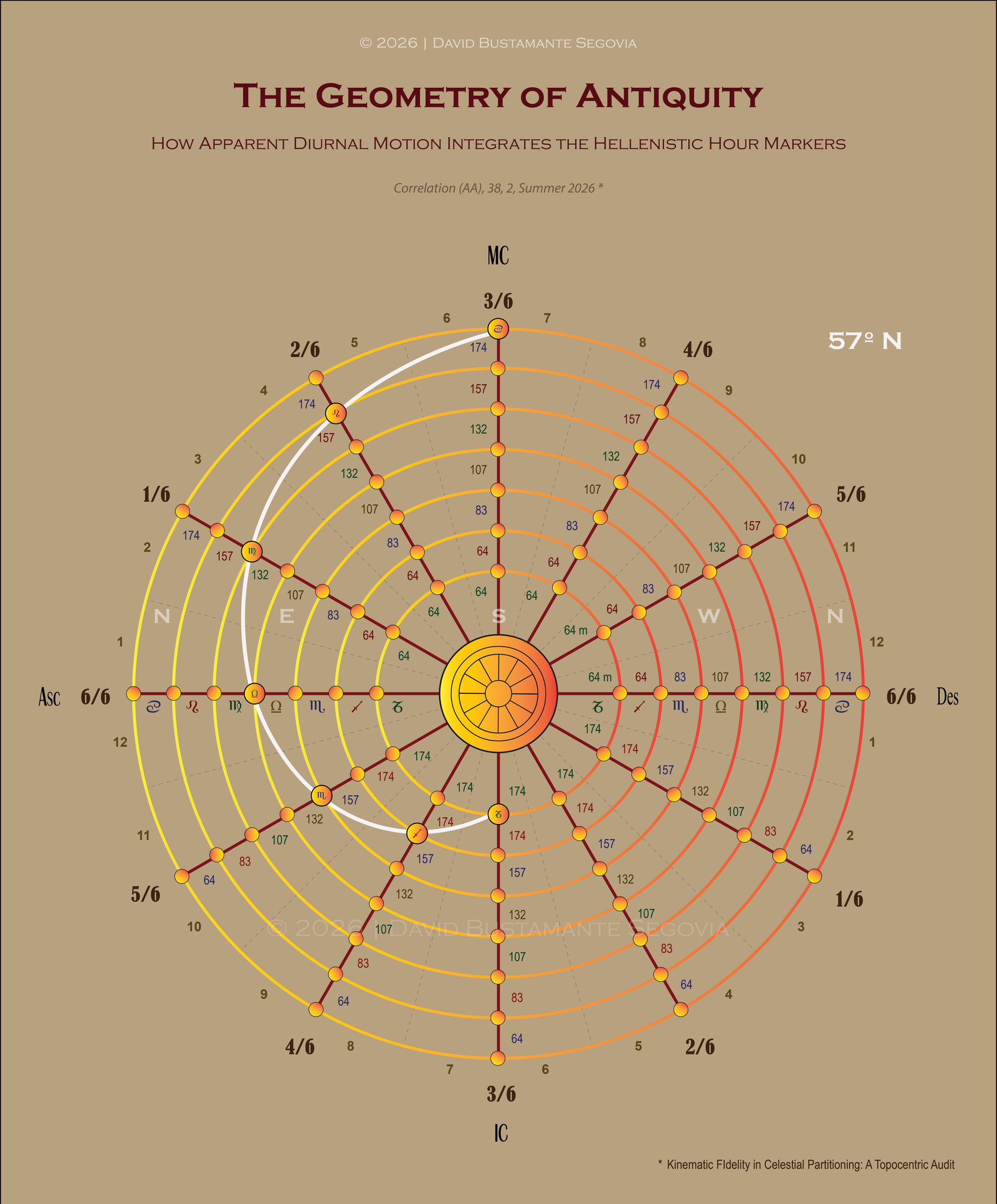
Because every coordinate along the ecliptic (the Tropical Zodiac) follows a unique trajectory relative to the local horizon, the ecliptic does not undergo displacement that is uniformly perpendicular, as it does during the equinoxes at equatorial latitudes. Instead, it continuously oscillates—a dynamic wobble mirroring the Earth’s rotational axis. Consequently, deriving the exact spatiotemporal fraction of any intermediate tropical zodiacal coordinate is never a matter of linear arithmetic; it strictly necessitates non-linear, differential calculus.
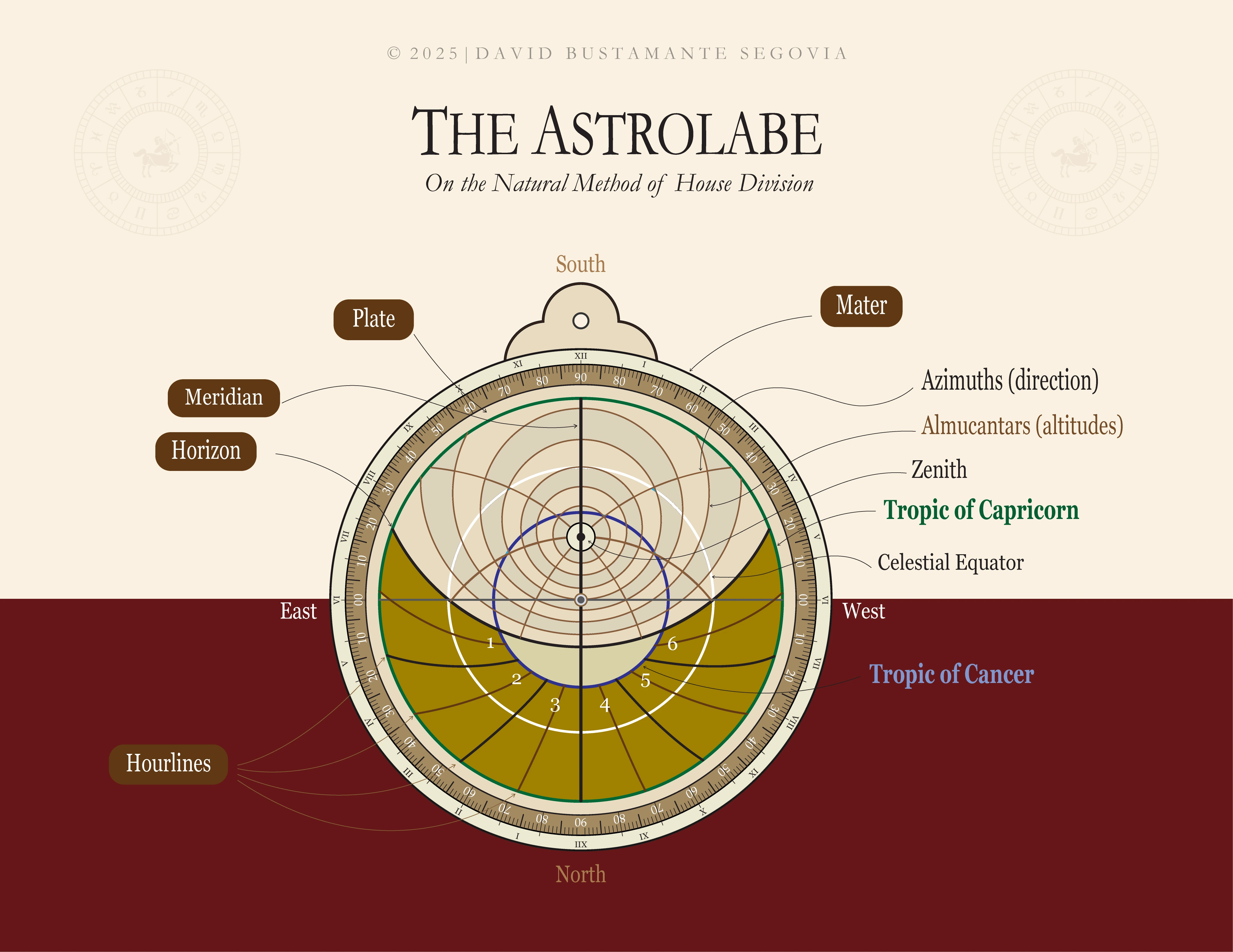
The concentric circles of the solar flux demonstrate this non-linear variation of altitude. This perfectly illustrates why oblique ascension constitutes an inescapable prerequisite: the ascent from the first third to the second covers a vastly different vertical distance than the ascent from the second to the third, despite the elapsed time being identical (two unequal hours from cusp to cusp, albeit along the semi-arc of a different ecliptic coordinate). This kinematic imperative—where the temporal fractions remain constant while the spatial locus curves—is precisely what the attached two-dimensional integration models.
Historical Fidelity: The Mechanics of the Planispheric Astrolabe
This kinematic complexity is not a modern theoretical projection; rather, it constitutes the foundational bedrock of classical astrometry. One needs only to examine the primary astronomical instrument of antiquity—the planispheric astrolabe—to observe this physical reality mechanically modeled.
Beneath the rete (the rotating lattice representing the ecliptic), the tympan contains the lines of unequal hours. These curves, which divide the diurnal arc into exact temporal fractions, are demonstrably not linear great circles. They are precisely calculated, non-linear trajectories representing the two-dimensional projection of the exact three-dimensional locus of points where every possible declination simultaneously achieves its proportional temporal milestone.
The Twentieth-Century Computational Retreat
It was precisely this realisation that presented an insurmountable challenge to twentieth-century revisionists. Confronted with the natural, time-proportional complexity of the local sphere, they experienced a profound theoretical dissonance, effectively equating geometric complexity with a mathematical flaw.
Eschewing the non-linear calculus required to track countless unique diurnal arcs, they enacted a computational retreat to static spatial geometry. They fabricated static poles and linear vectors to compel the celestial sphere into a uniform grid. Placidus did not invent a mathematical anomaly in the seventeenth century—unlike Polich, who achieved exactly that in the twentieth century when, in replicating Placidus, he fabricated a linear construct. Placidus, in turn, merely provided the formal spherical trigonometry for the exact same curved, unequal hour lines that classical astronomers had been calculating since antiquity.