Physical Address
The Woodlands, TX, USA
Physical Address
The Woodlands, TX, USA

The Archaeological Fallacy, or Antiquity’s Handicap
An ingenuous bias prevails amongst “traditionalist” practitioners: the conflation of archaeological frequency with epistemological truth. Because the majority of extant ancient charts depict symbolic, sign-based boundaries—frequently demarcating solely the Ascendant (Asc) and Midheaven (MC)—many practitioners erroneously conclude that antiquity possessed a doctrinal preference for the symbolic over the physical.
This represents a profound failure of forensic reasoning. Antiquity documented the Asc and MC primarily because these coordinates constitute the “visual anchors” of the physical horizon and the local meridian; they remain the sole spatial vectors verifiable through unaided observation. The subsequent stages or cusps were not omitted because they were deemed structurally insignificant (see Vettius Valens, The Anthology, 2022, pp. 121-122, 133, 138-139, 243-244, 253, 265), but rather because early astronomers lacked the spherical dexterity required to accurately trisect the varying diurnal arcs—of distinct ecliptic/tropical zodiacal coordinates—across varying latitudes.
To equate exogenous demarcations—the inert boundaries between the segments of the ecliptic (signs)—with endogenous demarcations—cusps (hour markers)—and to elevate this equivalence to the status of dogma, is to conflate a logistical limitation of antiquity with a deliberate philosophical doctrine. Consider a hypothetical scenario wherein archaeologists, two millennia hence, excavate thousands of rudimentary paper maps yet recover only three fragmented GPS devices. The “traditionalists” of that era would undoubtedly argue that the paper map represented the definitive “True Tradition.”
The historical reality is decidedly more pragmatic: the paper map merely reflected the limits of prevailing material utility and computational accessibility. To adhere strictly to exogenous celestial boundaries in the modern era—whilst simultaneously asserting a planetary body’s efficacy by virtue of its ascensional stage—is to voluntarily adopt a two-thousand-year-old metrological handicap.
The Ad Hoc Exemption, or the Absurdity of Two Types of Physics
Perhaps the most profound inconsistency inherent in models alienated from the local sky lies in their application of high-precision timing techniques (Primary Directions). Traditionalist practitioners routinely concede that celestial mechanics track a planetary body to the exact minute of arc to determine a critical life event or terminal crisis; yet, they simultaneously postulate that for the foundational architecture of the nativity, the cosmos defers strictly to arbitrary 30-degree volumetric blocks.
This constitutes a textbook ad hoc fallacy—positing that the physical laws of the local sphere mutate depending upon whether we are auditing a vocational trajectory or a discrete event. It is metrologically analogous to a military tactician relying upon a flat, two-dimensional schematic to plot an incursion, only to suddenly demand a three-dimensional topographic model the moment engagement initiates. If the three-dimensional topography is strictly requisite for calculating survival, the two-dimensional schematic was structurally invalid from the outset.
Such a methodological contradiction represents a severe violation of systemic synergy. A natural or mathematically valid house cusp is, in strict geometrical reality, nothing more than a “frozen” Primary Direction. To embrace kinematic or “high-resolution“ timing for calculating the exact moment of death, whilst simultaneously rejecting the kinematic or “high-resolution“ physical cusp for the House of Death itself, is to acknowledge the destination whilst denying the existence of its road.
The Paradox of the “Sharp Point” (kentron)
Historical texts and contemporary Hellenistic reconstructions define the angles as a kentron. The primary Greek etymology of the term denotes a “sharp point” (a goad intended to spur a planetary body into action), a geometrical “centre” (such as the centre of a circle), or a “pivot” (akin to the fixed leg of a compass). Further highlighting this localised precision, historical translations of the concept include the Indian kantaka (“spike”) and the Arabic watad (“stake”).
The forensic scrutiny
When the whole-sign angular triad model is subjected to strict geometry, a critical etymological and kinematic paradox emerges: how can a kentron—literally denoting a sharp spike, a stake, or the fixed point of a compass—span thirty degrees of volumetric amplitude? To stretch a “sharp point” across a vast, thirty-degree sector stands in flagrant contradiction to both the etymology of the tradition (see Valens, 2022, Book III, p. 265) and the physics of the local horizon.
Consider an Ascendant stationed at 15° Leo. Geometrically, the fraction of the ecliptic between 00° and 15° Leo is incontrovertibly situated above the eastern horizon, occupying the physical space proper to the twelfth house. This zone corresponds to a period of cadent luminous intensity, given that its energetic discharge was consummated the moment it breached the horizon. Nevertheless, by forcing the inception of the first house at 00° of the sign, modern traditionalist epistemology assigns angular power to fifteen coordinates that, in topocentric reality, have already crossed the horizon and lost momentum (precipitating away from the angle). The “goad” ceases to be a point of kinematic precision, transmuting instead into a vast, blunt surface that is ultimately geometrically decoupled from the local sphere.
The Sniper Metaphor
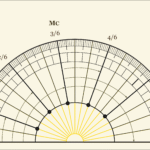
Whilst precise metrology recognises that the diurnal arc possesses zonal gradations—where the space between the culmination (3/6 of the diurnal trajectory, or 50% of that cuspal degree’s path) and the succedent cusp (2/6 or 33.33%) constitutes the area of angular force—the exact degree of that culmination (the MC) inexorably prevails as the absolute hour-marker of culmination. Consequently, any coordinates that have already culminated (having reached their maximum altitude relative to the local horizon) no longer belong to the trajectory leading towards culmination; rather, they belong to the trajectory precipitating towards their setting. This kinematic reality mirrors the preceding example, wherein 00° to 15° Leo do not constitute the trajectory leading to ascension, as they have already consummated it.
If the Midheaven is positioned at 05° Aries, granting the entirety of the sign an identical status of “angularity” actively ignores the physical gradation of diurnal motion. It is mathematically analogous to asserting that a sniper exerts the exact same “power” over a target that has already crossed the crosshairs and is moving thirty metres beyond into the treeline, as they do when tracking the target’s approach or holding it immobilised precisely within the centre reticle.
No military tactician would endorse such a structural absurdity. The crosshairs (the exact coordinate of the angle) and the imminent trajectory culminating within them constitute the sole locus of maximum power. To maintain that the entire valley is the mountain is to privilege a nominal label at the expense of non-negotiable physical momentum.
The Kinetic Contradiction (The Dual Motion Engine)
The local horizon operates as a diurnal rotational engine—an inherently three-dimensional kinematic process. Traditional texts correctly rely upon directional verbs to describe this mechanism, stipulating that planetary bodies “fall” (cadent) or “ascend” (succedent) toward the horizon or the local meridian. However, it is physically impossible to “decline” or “ascend” relative to an inert, exogenous boundary projected entirely outside the terrestrial sphere (i.e., the ecliptic segment or the zodiacal sign itself). Such a kinematic phenomenon can only occur relative to physical points of topocentric anchorage, with the local horizon and meridian standing as the most self-evident and empirically observable anchors.
Under an arbitrary demarcation model, a planetary body may be positioned within a nominally “angular” sign—theoretically assumed to be in a state of culmination—when, in strict physical reality, it has already entered the cadent phase and consequently lacks all angularity.
The Metaphor of the Soldier and the Barracks
To maintain that a planetary body’s efficacy transmutes the exact instant it crosses a zodiacal boundary is structurally equivalent to claiming a soldier has arrived “at the barracks” the moment his boot crosses a cadastral line drawn upon a paper map—even whilst the physical edifice remains kilometres away down the road. The sign merely constitutes an arbitrary property line; the topocentric angle (the cusp) is the actual, physical location of the barracks to which the soldier has yet to arrive.
The Fallacy of Mistaking the Map for the Territory (Ghost Houses)
By anchoring the first and tenth houses to the physical Ascendant and Midheaven, yet abandoning the intermediate space (the second, third, eleventh, and twelfth houses) to the arbitrary dictate of an exogenous demarcation (alien to the local horizon), linear models engender geometric ghosts. Consequently, they produce illusory interpretations, as they are completely devoid of the physical mechanics from which all symbolism emanates.
The Metaphor of the Paper Bridge and Polar Kinematics
Assigning power to the angles whilst projecting whole signs or equal houses across the intermediate space is mathematically analogous to an engineer erecting the two master pillars of a bridge with steel and concrete (houses one and ten), only to subsequently expect pedestrians to cross the abyss by walking upon the paper blueprint of the design (houses eleven and twelfth houses). The paper bears the written measurements, but it utterly lacks the physical structure necessary to support the weight. By decoupling the intermediate houses from diurnal motion (oblique ascension)—a kinematic reality Valens explicitly demanded (The Anthology, 2022, pp. 121-122, 138-139)—the system collapses upon first contact with spherical topography.
At high latitudes, this structural fracture and spatiotemporal negligence reach the paroxysm of absurdity. Given that spacetime (in its classical kinematic sense) comprised between the horizon and the local meridian can violently compress or expand—due to a nearly parallel ascension of the ecliptic relative to the horizon, forcing the rising of multiple signs quasi-simultaneously—linear models impose 30-degree spatiotemporal segments (exactly two equatorial hours) precisely where the ecliptic’s trajectory assumes a drastically oblique displacement. Thus, they remain floating as abstractions, completely dissociated from the local firmament. They purport to audit the mechanics of a celestial vault that, at the level of raw calculus, they have entirely ceased to observe.
A mathematically valid—or natural—house, strictly irrespective of topocentric latitude, invariably dictates an exact duration of two oblique hours (diurnal or nocturnal horae temporales) rather than equatorial hours, with the sole exception of the equinoxes. This kinematic axiom remains inviolable, even when oblique hours undergo extreme compression, reducing them to mere seconds of chronometric time. In turn, the cuspal degree inexorably retains a highly specific altitude and azimuth, given that these coordinates operate as true “solar footprints.” The reality that, at extreme latitudes, the totality of degrees capable of ascending is restricted to a finite ecliptic arc—thereby precluding the ascension of the full 360-degree spectrum—does not alter this premise in the slightest. By strict geometric imperative, every native will invariably possess an Ascendant.
The Geometric Handcuffs
The “geometric handcuffs” dictated by the local horizon possess a strictly non-negotiable character. We do not seek to overthrow the tradition, but to consummate its mathematical promise. Antiquity was, above all, populated by observers who stroved tirelessly for the light of metrological precision (Valens, The Anthology, 2022, pp. 243-244, 253, 265); to halt today at the precise threshold where they were forced to capitulate due to severe computational limitations (see Valens’ own lamentations concerning the negligence of others with respect to exact calculations, pp. 123, 137, 244) constitutes an intellectual abdication and a refusal to carry the torch to its final destination. The physical horizon does not ask for our permission to exist where it does; it requires only the honesty of our measurements.
Consummating the Mandate
To achieve this metrological honesty, one must strip away centuries of computational shortcuts and simplify the foundational premise. All Ascendants and Midheavens are, and always have been, intrinsically “Placidian”: the primary axes are by definition the product of the corresponding ratio of an oblique ascension. Irrespective of the partitioning method employed, the cusp of the First House strictly constitutes exactly six-sixths (6/6) of its nocturnal arc, whereas the cusp of the Tenth House constitutes exactly three-sixths (3/6) of its diurnal arc. Consequently, the primary axes (Ascendant and Midheaven) are governed by the proportional semi-arc of their respective coordinates, establishing that every quadrant measures exactly half of the diurnal or nocturnal arc of the relevant culminating or anti-culminating coordinate. It geometrically follows that to divide this quadrant into three equal astrological houses, each intermediate cusp must axiomatically represent an equipartite temporal segment equivalent to exactly one-sixth (1/6) of the total diurnal or nocturnal arc of the specific coordinate occupying that cusp.[1]
Placidus did not invent a new calculation; he merely completed the geometric mandate of the hōroskopos (hour markers) across the intermediate space. Space and time cannot be decoupled.

The ancient Greeks relied upon the angular, succedent, and cadent triad (kentron, epanaphora, apoklima). Those concepts are direct translations of verbs describing diurnal motion (pivoting, rising up toward, falling away from). They describe kinetic energy, not static 30-degree zodiacal buckets. Whilst we must acknowledge the monumental philological labor of those experts who resurrected and translated our primary sources, their systemic flaw lies in reading verbs of motion and mistaking them for static spatial blocks, fundamentally due to a disconnect from the geometry of time. The ancients were entirely correct; it is the modern revival that has misunderstood them.
___________
[1] Because the full kinematic span of any diurnal or nocturnal arc constitutes exactly twelve seasonal (or oblique) hours, this one-sixth partition equates strictly to a duration of two seasonal hours. Unlike fixed 60-minute equatorial hours, seasonal hours are dynamic temporal units that naturally expand or contract in accordance with the coordinate’s declination and the observer’s local latitude).