Physical Address
The Woodlands, TX, USA
Physical Address
The Woodlands, TX, USA

In 1998, DEBORAH HOULDING rightly maintained, “[…] most of us would find that our ability to prove one house system works is a great deal stronger than our ability to prove that another system doesn’t” (p. 106).
In order to overcome this empirical limitation and establish an objective method of refutation, in November 2025 we published Astronomical Fidelity of Celestial Partitioning Coordinate Systems: A Quantitative Comparison of Linear vs. Non-Linear Methodologies, and subsequently, in July 2026, Kinematic Fidelity in Celestial Partitioning: A Topocentric Audit, in the British research journal Correlation (Vol. 38, No. 2), a synthesis of the aforementioned manuscript.
Furthermore, it must be understood that a mathematical procedure that respects the kinematic phenomenon responsible for the first house cusp and applies said methodology consistently with respect to the subsequent cusps bears no burden to prove its correctness. Those who allow nature, not authority, to govern their research are never tasked with proving that the natural mechanics of the celestial sphere continue to operate across the entirety of the observer’s horizon. Natural law requires no such defence. The burden of proof rests upon those who fervently defend an artificial regimentation.
If practitioners wish to distinguish themselves as champions of alternative frameworks that rely upon deliberate geometric fictions, they must justify those artificial intersections (cuspal times of arrival). It is a profound structural irony that proponents of these systems demand statistical validation for subsequent cusps, ignoring the fact that statistics do not constitute, nor have they ever constituted, the methodology employed to establish the Ascendant (Asc) or the Midheaven (MC). The failure to apply a consistent or uninterrupted methodology originates from an epistemological fracture, namely, in the comprehension of the definition of a cusp.
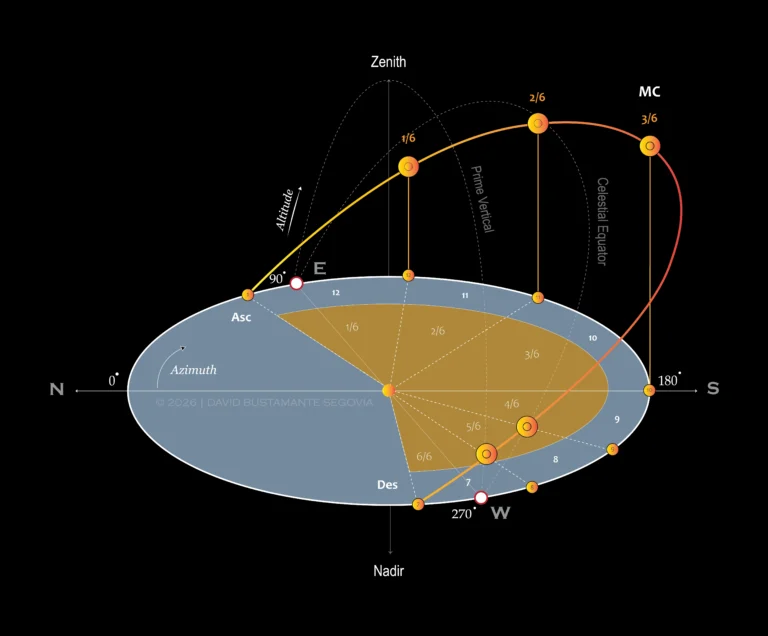
Instead of observing the unbroken kinematics within software such as Stellarium or Solar Fire Gold (where one can visually confirm that diurnal motion does not alter its behaviour the moment a coordinate crosses the horizon on its path toward the meridian), the discipline frequently defaults to institutional repetition. To assume that frames of reference foreign to oblique ascension (the celestial equator, the prime vertical, etc.) represent distinct and equally valid perspectives of diurnal motion, rather than structural approximations born of historical computational limitations, borders on intellectual negligence, for it is tantamount to maintaining that, because different brands of thermometers exist, temperature itself constitutes a matter of preference or opinion. However, there are not three or six different diurnal motions; there is one. The time of arrival of a zodiacal coordinate at a specific azimuth and altitude of the local horizon (with or without parallax, atmospheric refraction, aberration of light, ∆T, etc.) is verifiable, unequivocal, and singular.
The mathematical invalidation of these structural abbreviations and the concurrent geometric validation of the Ptolemaic method has already been exhaustively mapped. This metrological audit, or forensic analysis, was conducted not out of a necessity to defend nature, but as a pedagogical intervention aimed at restoring foundational epistemological and astronomical literacy within the astrological discipline. Beyond that, the geometry rests.
* * *
To observe the aforementioned deficit is not an act of arrogance (a common evasion employed to elude the mathematics of diurnal motion), but merely the reflection of a reality that the community itself already implicitly concedes. The mere existence of remedial curricula titled “ASTRONOMY FOR ASTROLOGERS” constitutes an institutional admission of said blatant epistemological, and also traditional, disconnection. Astrological interpretation is not an independent artistic exercise suspended in a vacuum (e.g. Tarot); it constitutes a derivative exercise, that is, the hermeneutic translation of a physical reality.
The most prominent astrologers in history were first astronomers, then astrologers; for them, the symbol was indissolubly bound to celestial mechanics. The contemporary tendency to sever this indissoluble bond, far from honouring tradition, constitutes an absolute abandonment of it.
The current state of discourse strongly suggests that a parallel education in “epistemology” and “formal logic” is a necessity of identical urgency, for there is a concerted desire to reap all the authoritative benefits of a science whilst simultaneously demanding the unaccountable privileges of a religion.
DAVID BUSTAMANTE SEGOVIA
6 JULY 2026
* * *
Table of Contents
To that end, the following index catalogues and objectively resolves the most prevalent geometric, astronomical, and methodological fallacies currently employed to evade accountability. Each misconception has been formally classified and mathematically dismantled.
Preface
The astrometric baseline
I. Axioms of Celestial Partitioning
Establishing the foundational kinematics of topocentric space
I.1. The Ecliptic Matrix
Axioms 1-4
I.2. The Mechanics of the Angles
Axioms 5-7
I.3. The Proportion of the Subsequent Cusps (Identical Mechanics)
Axioms 8-13
II. Objective Resolution Of Prevalent Geometric And Astronomical Misconceptions In Celestial Partitioning
Theme I: Foundational Astronomical Literacy
II.1. The Disentanglement of Diurnal Rotation from Orbital Anomalies
Resolving the foundational failure to distinguish between annual orbit and daily rotation
II.2. The Measurement of Spatial Coordinates: An Empirical Falsification
Resolving the error that empty coordinates cannot be computationally measured
II.3. The Visual Proxy as a Calibration Benchmark
Resolving the error of confusing the visual proxy (the Sun) with the structural matrix
Theme II: Mathematical & Statistical Distortions
II.4. The Inviolability of Geometric Proportion
Resolving the flawed attempt to use theoretical relativism to avoid solving trigonometric fractions
II.5. The Conflation of Metrological Exactitude and Statistical Tolerance
Resolving the admission that wide orbs are used to mask kinematic inaccuracies
II.6. The Conflation of Geometric Validation with Statistical Regression
Resolving the epistemological error of demanding statistical regression to validate subsequent cusps whilst exempting the primary cusps
II.7. The Inseparability of Space and Time in Celestial Kinematics
Resolving the error of pretending a geometric coordinate is immune to the amount of time required to reach it, or of artificially divorcing spatial coordinates from their temporal milestones
II.8. The Disentanglement of Geometric Definition from Computational Resolution
Resolving the error of conflating a spatiotemporal kinematic reality with the iterative search engine required to ascertain it
II.9. The Disentanglement of Exact Event Manifestation from Kinematic Fidelity
Resolving the error of using the natural temporal variance of observed events to justify underlying geometric inaccuracy
II.10. The Disentanglement of Extreme Kinematic Velocity from Biological Observation
Resolving the fallacy of using the technological limitations of human data collection to invalidate the geometric reality of an extreme topocentric matrix
Theme III: The Collapse of Academic Methodology
II.11. The Methodological Schism Between Natal and Predictive Kinematics
Resolving the Ad Hoc fallacy of abandoning spatiotemporal fidelity in the natal matrix whilst demanding its strict return for predictive timing
II.12. Metrological Verification vs. Theoretical Invention (The Cartography Analogy)
Resolving the methodological failure of confusing a computational audit with a claim of invention
Access the Complete Manuscript
The full 24-page manuscript, containing the foundational axioms and the exhaustive geometric resolution of each fallacy indexed above, is available for download here.